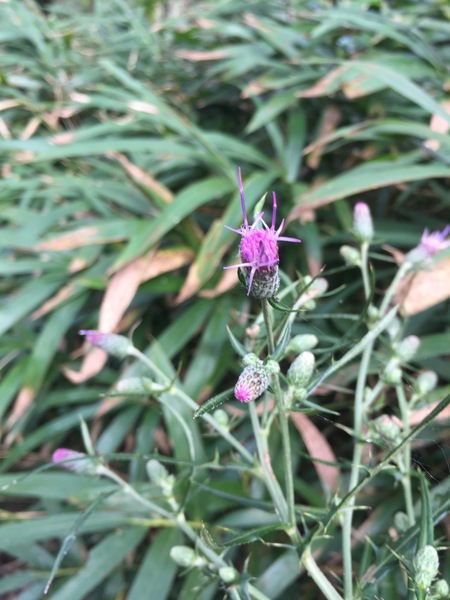
Japanese name: ヒメアザミ(姫薊) Scientific name:Cirsium buergeri
[Overview]
A perennial growing at forest edges and in grasslands in low mountains to mountains.
A thistle found in part of Honshu (Shiga, Yamaguchi) and in Kyushu.
The stem is erect or ascending, sometimes over 2 m tall, and branches in the upper part, with the branches spreading at wide angles.
The stem has multicellular soft hairs and cobwebby hairs.
There are basal leaves and stem leaves; the basal leaves have withered by flowering time.
The stem leaves are alternate, evenly spaced along the stem, elliptic to ovate, 15–33 cm long and 6–20 cm wide.
The leaves are pinnately divided into 3–6 pairs of lobes, each lobe tipped with a sharp spine; the upper surface has brown hairs and the underside has cobwebby hairs.
The leaves sometimes have white blotches along the veins.
They have a petiole, or are stalkless with the base somewhat ear-shaped and clasping the stem.
Pale reddish-purple flower heads are borne sparsely at the stem tip in racemes to corymbs.
The involucre is cylindrical, about 1 cm wide, with the bracts pressed closely together in 8–9 rows.
The inner and middle bracts of the involucre have glands and are very sticky.
The fruit is an achene with a pappus.