
Plant Encyclopedia

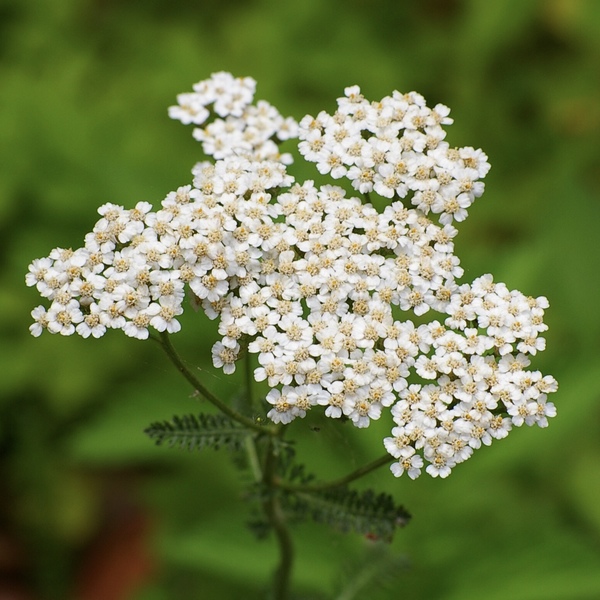
Achillea millefolium (common yarrow, "Seiyonokogiriso")
Japanese name: セイヨウノコギリソウ (西洋鋸草)
Scientific name: Achillea millefolium
[Overview]
A perennial 60–80 cm tall, cultivated since ancient times as a medicinal plant.
In its native range it is commonly seen in vacant lots and along roadsides.
It spreads by underground stems and grows thickly.
The leaves are alternate, 5–20 cm long, and finely divided two to three times pinnately.
Corymb-like inflorescences at the stem tips bear many small white to pale pink flower heads densely.
Each flower head has 5 ray florets.
[History]
Known as a medicinal herb since ancient times, it is said that the ancient Greek hero Achilles taught its efficacy.
In medieval Europe it was believed to have the magical power to ward off evil spirits, and it was also used in wedding bouquets and for love divination.
It was introduced to Japan in 1887 (Meiji 20) as an ornamental, but because of its strong reproductive power it has become naturalized in some places.
[Uses]
The whole plant has tonic, stomachic, sweat-inducing and fever-reducing effects.
The leaves are also used for burns, cuts, toothache and the like.
It is also used as herbal tea.
The young leaves are eaten raw as a salad, and are sometimes boiled and eaten.
They have a light flavor, and as they grow larger the pungency increases and a peppery flavor develops.
They are chopped and added to salads.
They are also sometimes boiled and eaten like spinach.
The dried and powdered plant was also used as a substitute for tobacco.
In Sweden it was used in brewing beer.
[Cultivation]
Propagate from seed, by division, or by shoot cuttings.
It prefers a sunny, well-drained site.
It is hardy and spreads by underground stems, so when planted in a garden it is better to make a frame underground to keep it from spreading too much.
For potted plants, water when the soil surface dries.
Fertilizer is not particularly necessary.
It dislikes heat and humidity, so keep it well ventilated.
Pests and diseases include aphids, powdery mildew and gray mold.
When the branches become crowded, they can become stuffy and disease may develop.
[Notes]
The Japanese name likens the shape of the leaves to a saw.
Details
Japanese: セイヨウノコギリソウ(西洋鋸草)、ヤロー、ヤロウ、コモンヤロウ
Translated from our Japanese encyclopedia. If anything differs, the Japanese page is correct.