
Plant Encyclopedia

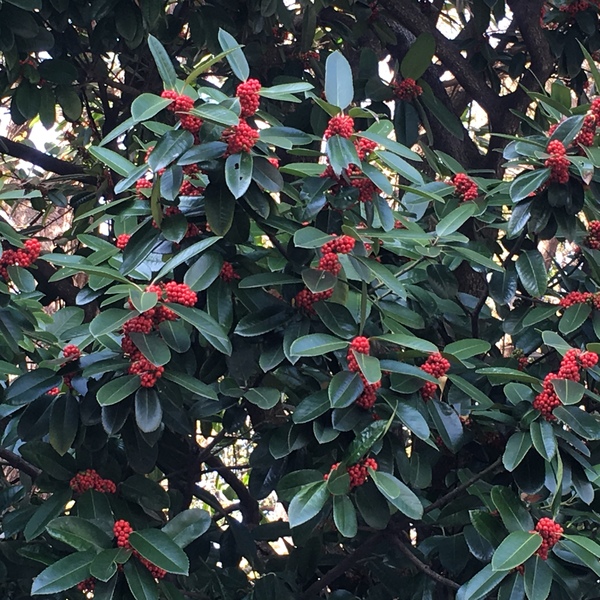
Ilex latifolia (tarajo holly)
Japanese name: タラヨウ (多羅葉)
Scientific name: Ilex latifolia
[Overview]
An evergreen tree 7–10 m tall that grows in evergreen forests; some are said to reach 20 m.
The leaves are simple and alternate, elliptic, 10–18 cm long and 4–7 cm wide.
The leaf tip is sharply pointed, and the margin has many fine, pointed teeth.
The petiole is 1.5–2 cm long.
The plant is dioecious.
Both male and female plants bear short panicles on short shoots in the leaf axils of the previous year's branches, each carrying many flowers.
The flowers are small, yellowish green, and 4-petaled.
The fruit is spherical, 8 mm in diameter, and ripens red.
[Cultivation]
Propagate by cuttings.
Growing from seed is also possible, but plants raised from seed will turn out to be both male and female.
To sow, harvest ripe fruit, wash off the pulp, bury the seeds in moistened vermiculite or similar so they do not dry out, and store them in a cool, dark place. Take them out the following March–April and wash them thoroughly again before sowing.
It is suited to warm regions south of Kanto.
It prefers sun to partial shade and well-drained, humus-rich, moderately moist soil.
Fruit set is better in good sunlight, but it dislikes strong afternoon sun and dry sites.
For potted plants, water thoroughly when the soil surface dries.
For plants in the ground, watering is unnecessary unless sunny weather continues for a long time and the soil dries out.
Fertilizer is not particularly necessary except on poor soil; if applied, dig holes in several places around the plant and bury compost as fertilizer in winter.
Pests and diseases include sooty mold and scale insects.
[Notes]
Scratching the underside of a leaf turns it blackish, so it can be written on.
This is reminiscent of postcards (hagaki), so it has been designated the "post office tree" and is often planted at post offices.
Heating a leaf over a fire also brings out a black ring.
The Japanese name derives from the "taraju" trees (palms such as the Ogi-yashi, the palmyra palm), whose leaves were written on with sutras.
Details
Japanese: タラヨウ(多羅葉)、ハガキノキ(葉書の木)、ジカキシバ(字書柴)、エカキシバ(絵書柴)、ジカキバ(字書葉)
Translated from our Japanese encyclopedia. If anything differs, the Japanese page is correct.