
Plant Encyclopedia

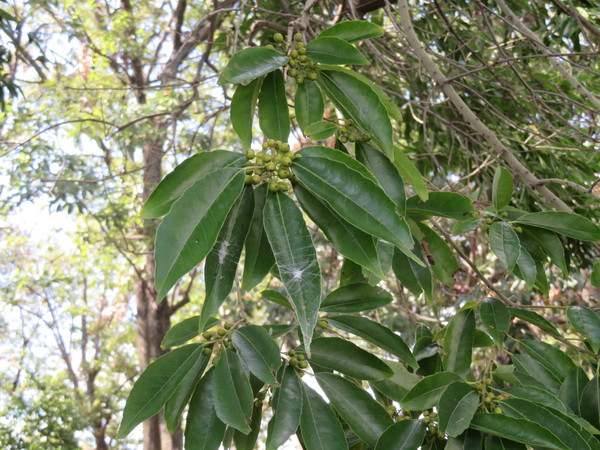
Ilex chinensis ("Nanaminoki")
Japanese name: ナナミノキ
Scientific name: Ilex chinensis
[Overview]
An evergreen tree 6–10 m tall, found in evergreen forests; some are said to reach 15 m.
Young branches are angular.
The leaves are simple and alternate, oblong, 6–12 cm long and 2.5–4 cm wide, with a narrowly pointed tip.
The leaf margins have coarse serrations.
The petiole is 0.8–1.5 cm long.
The plant is dioecious.
Male inflorescences arise in the leaf axils of the current year's branches and bear 2–12 male flowers.
Female flowers are borne 1–2 in the leaf axils.
The male and female flowers are small and pale purple.
Hermaphrodite flowers are rarely produced.
The fruit is elliptical, 1 cm long, and ripens red.
[Uses]
The fruit, bark and leaves are used medicinally.
[Cultivation]
Propagate by cuttings.
Growing from seed is also possible, but plants raised from seed will turn out to be both male and female.
When sowing, harvest ripe fruit, wash off the pulp, bury the seeds in moistened vermiculite or similar so they do not dry out, and store them in a cool, dark place; take them out in March–April of the following year and wash them thoroughly once more before sowing.
It is suited to warm regions from the Kanto area southward.
It prefers fertile soil in a sunny, well-drained site.
It fruits better in a sunny position, but dislikes places exposed to strong afternoon sun.
For plants in the ground for less than 2 years, water thoroughly when the soil surface dries; for established plants, rainfall is sufficient unless sunny weather continues in summer and the soil dries out.
In winter, apply organic fertilizer by digging several holes around the plant and burying it.
Pests and diseases include sooty mold and scale insects.
[Notes]
There are several theories about the origin of the name, such as that it derives from "nanami" (seven fruits) because it bears many beautiful fruits, or that it is a corruption of "naga-mi" (long fruit) because the fruit is long and narrow.
Details
Translated from our Japanese encyclopedia. If anything differs, the Japanese page is correct.