
Plant Encyclopedia

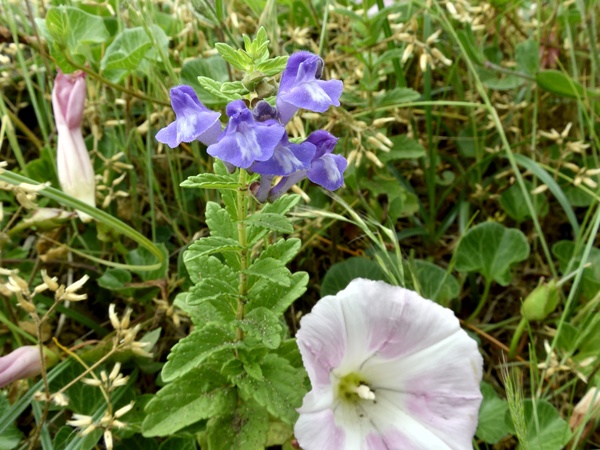
Scutellaria strigillosa ("Namikiso")
Japanese name: ナミキソウ (浪来草)
Scientific name: Scutellaria strigillosa
[Overview]
A perennial 10–50 cm tall, growing on sandy coasts.
It sends slender runners underground.
The stem is square in cross section, much branched, and covered with short upward-pointing hairs.
Leaves are simple and opposite, oblong, 1.5–3.5 cm long and 1–1.5 cm wide, somewhat thick, with blunt serrations on the margins.
Both surfaces of the leaves are hairy.
They have petioles.
The flowers are solitary in the upper leaf axils, two at each node, facing the same direction.
The corolla is bluish purple and two-lipped, about 2 cm long; the tube bends at the base and stands almost upright, and the upper lip is helmet-shaped.
The fruit is a schizocarp.
[Cultivation]
Propagate from seed, by division, or by stem cuttings.
It prefers a sunny, well-drained, well-ventilated place.
It dislikes excess moisture, so for potted plants water thoroughly after the soil has dried, and for plants in the ground rainfall is sufficient.
Too much fertilizer makes it grow too dense and spoils its form, so if fertilizer is applied at planting, no further fertilizer is particularly needed.
There are no particular pests or diseases.
Details
Translated from our Japanese encyclopedia. If anything differs, the Japanese page is correct.