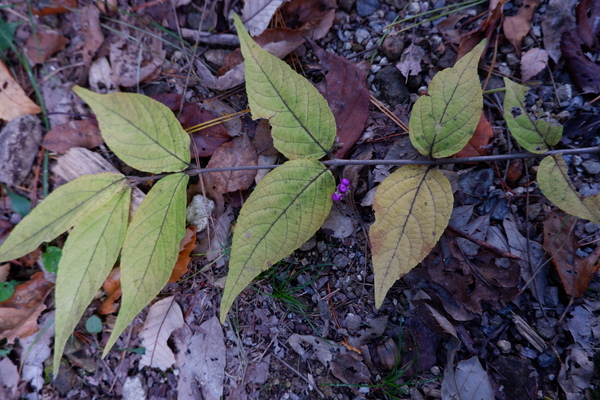
Japanese name: ヤブムラサキ(薮紫) Scientific name:Callicarpa mollis
[Overview]
A deciduous shrub 2–3 m tall.
It is commonly seen in somewhat dry places in deciduous woodland in mountains and lowlands.
The branches, leaves, inflorescences and calyx are densely hairy.
The leaves are opposite, broadly ovate to ovate-elliptic, 5–10 cm long and 2–5 cm wide, with serrations.
The petiole is 0.5–0.7 cm long.
The leaves turn yellow in autumn.
Cymes are borne in the leaf axils, each with 2 to a dozen or so flowers.
The inflorescence has a stalk 0.5 cm long.
The flowers are reddish purple and about 4–5 mm long, and the corolla is 4-lobed.
The fruit is spherical, 3–4 mm across, ripens purple, and its lower half is enclosed by the calyx.
[Cultivation]
Propagate from seed or by cuttings.
It prefers a sunny site with moisture-rich soil.
It tolerates partial shade, but flowering and fruiting become poorer if sunlight is insufficient.
It is very tolerant of cold and heat.
Scale insects may attach to it.
[Notes]
The Japanese name is said to derive from the way the leaves grow thickly, making the plant look like a thicket.