
Plant Encyclopedia

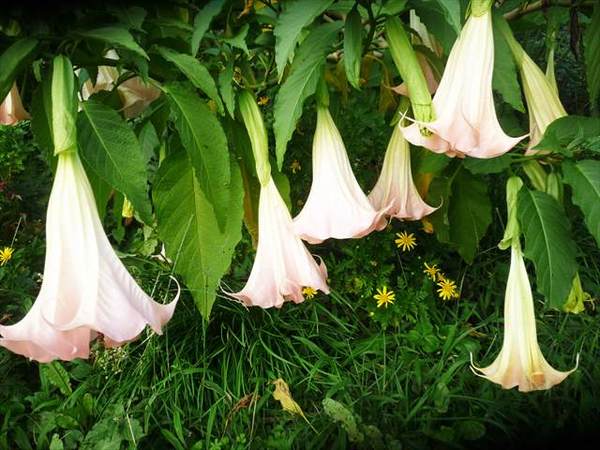
Brugmansia suaveolens (Angel's Trumpet, "Kidachichosen'asagao")
Japanese name: キダチチョウセンアサガオ (木立朝鮮朝顔)
Scientific name: Brugmansia suaveolens
[Overview]
A shrub or small tree growing to about 3–10 m.
The leaves are simple and alternate, large, with wavy or entire margins.
The flowers are borne singly in the leaf axils and hang downward; they are trumpet-shaped to tubular with a widely open tip, about 10–50 cm long.
The corolla is shallowly 5-lobed, and the tips are pointed like horns and curve back.
The neck of the flower tube is narrowly constricted.
Many of the flowers are fragrant at night.
Flower colors include white, orange, yellow and pink, and there are also double-flowered forms.
The calyx is long and tubular.
[Cultivation]
It is easy to grow and does well in fertile soil containing humus.
It prefers a sunny location, but in summer it needs shading to keep it out of direct sunlight.
For potted plants, water thoroughly when the soil surface begins to dry.
Do not let fertilizer run out during the growing season from spring to autumn; apply solid fertilizer such as oil cake.
If it is not pruned, it becomes leggy and loses its shape, so it is better to cut it back hard in early winter.
It can overwinter in the open ground if it is not exposed to freezing or frost.
In warm regions it can be grown large, and a freely flowering plant can produce a total of more than 100 flowers.
Propagate from seed, by cuttings, or by layering.
Pests include armyworms and spider mites.
[Notes]
A poisonous plant containing alkaloids and other compounds.
Kidachi-chosenasagao is the Japanese name applied to Brugmansia suaveolens, but the plants widely cultivated in Japan are seldom this species, and most are hybrid cultivars.
There is also Kodachi-chosenasagao (Brugmansia ×candida).
Details
Japanese: キダチチョウセンアサガオ(木立朝鮮朝顔)、オオバナチョウセンアサガオ、カシワバチョウセンアサガオ、コダチチョウセンアサガオ
Translated from our Japanese encyclopedia. If anything differs, the Japanese page is correct.