
Plant Encyclopedia

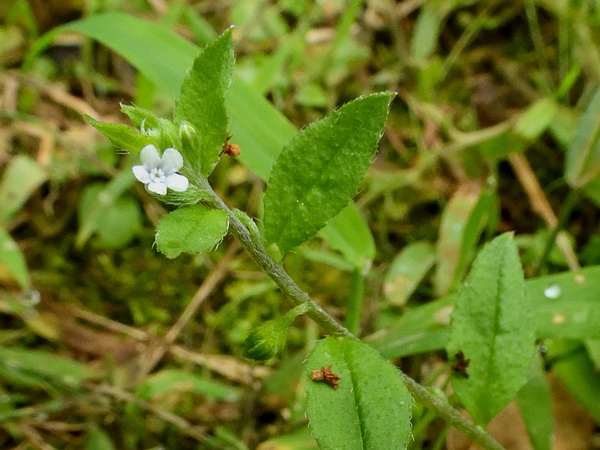
Bothriospermum zeylanicum ("Hanaibana")
Japanese name: ハナイバナ (葉内花、葉萎花)
Scientific name: Bothriospermum zeylanicum
[Overview]
An annual or biennial growing in fields and by roadsides.
In plants that behave as biennials, the basal leaves form a rosette, and the stems branch well at the base and spread flat, reaching up to 30 cm in length.
In plants that behave as annuals, no basal leaves appear, and the stem rises erect from the base, branches in the middle, and the branches extend obliquely upward.
The stem is slender and has upward-pointing hairs.
The stem leaves are alternate, and both basal and stem leaves are simple.
The basal leaves and the lowest stem leaves are spoon-shaped with wavy margins and long petioles.
The stem leaves are elliptical and almost sessile, becoming gradually smaller toward the top and turning into leaf-like bracts.
Both surfaces of the leaves have coarse hairs, and the margins are also hairy.
Flowers are borne sparsely in the inflorescence at the stem tip.
The inflorescence has bracts all the way to the top.
The flowers are borne singly in the axils of the bracts, about 2–3 mm across and pale blue-purple; the corolla is 5-lobed and the appendages in the throat are the same color as the corolla.
The fruit consists of mericarps, covered all over with granular projections.
It can be distinguished from Kyuri-gusa by the smell of the leaves and the bracts of the inflorescence.
[Notes]
There are two theories about the name: one takes it as "flower within the leaves" because the flowers are found between the leaves, and the other as "wilting-leaf flower" because the wavy leaves look as if they are wilting.
Details
Translated from our Japanese encyclopedia. If anything differs, the Japanese page is correct.