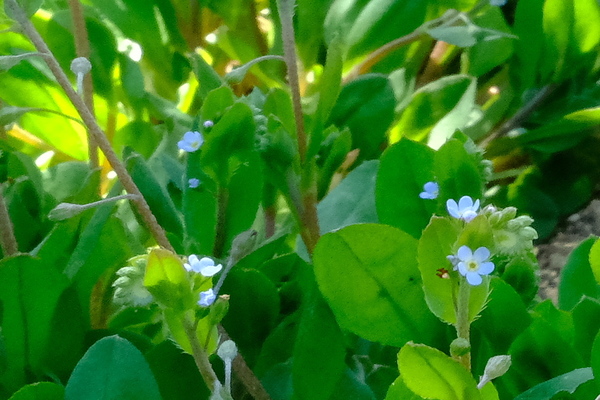
Japanese name: キュウリグサ(胡瓜草) Scientific name:Trigonotis peduncularis
[Overview]
A biennial about 15 cm tall, growing in fields and by roadsides.
The stem is 5–40 cm long and rises obliquely.
There are basal leaves and stem leaves; the basal leaves and the leaves on the lower part of the stem have petioles.
The leaves are simple and alternate, oblong to ovate, 1–3 cm long and 0.6–1.5 cm wide.
A raceme at the stem tip bears flowers sparsely.
The inflorescence has no bracts except at the base.
The flowers are pale blue, about 2 mm across, and the corolla is 5-lobed.
The inflorescence elongates after flowering.
The fruit is a schizocarp.
[Uses]
The whole plant is used as a folk medicine.
[Notes]
The name comes from the cucumber-like smell given off when the leaves are rubbed.