
Plant Encyclopedia

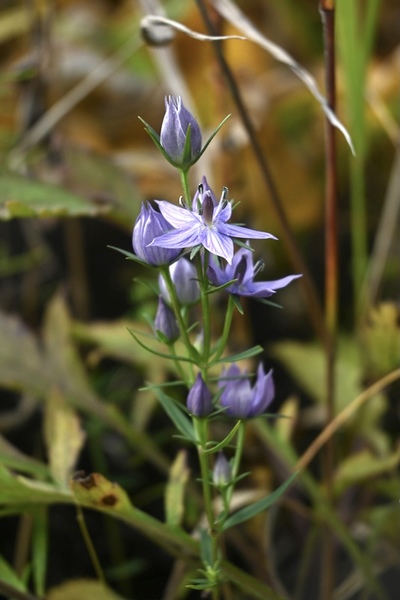
Swertia pseudochinensis ("Murasakisenburi")
Japanese name: ムラサキセンブリ (紫千振)
Scientific name: Swertia pseudochinensis
[Overview]
An annual or biennial about 30 cm tall, found in sunny grasslands.
Some plants are said to reach 50 cm or more, occasionally 1 m.
The roots are yellow and thick.
Raised fine dots occur on the ridges of the stem, on the upper part of the flower stalks, and on the margins of the calyx lobes.
The stem is erect, thick, much branched, usually tinged dark purple, and has 4 ridges.
The leaves are simple, fairly densely opposite, linear to linear-lanceolate, 2–5 cm long, pointed at both ends, and stalkless.
The leaves are sometimes tinged dark purple.
It bears panicles.
The flowers are pale purple with purple veins, and the corolla is deeply 5-lobed (sometimes 4–7-lobed).
The fruit is a capsule.
[Uses]
The whole plant is bitter and is used medicinally.
Details
Translated from our Japanese encyclopedia. If anything differs, the Japanese page is correct.