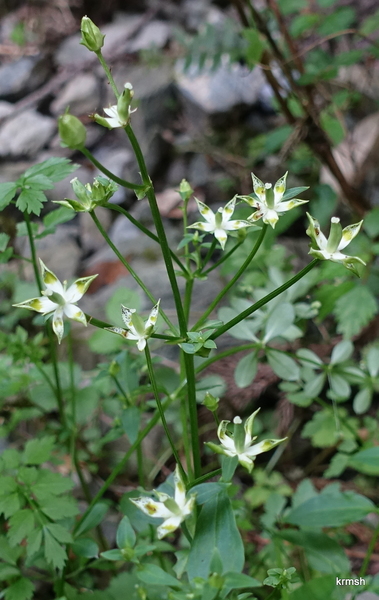
Japanese name: アケボノソウ(曙草) Scientific name:Swertia bimaculata
[Overview]
An annual or biennial 0.3–1.2 m tall, found in damp places.
The stem is erect and branches.
There are basal leaves and stem leaves; the basal leaves have withered by the flowering season.
The stem leaves are simple and opposite, ovate to lanceolate, 5–10 cm long and 2–4 cm wide, with 3–5 conspicuous veins.
The leaf margins are entire.
The leaf stalk is 1–1.5 cm long.
It bears panicles.
The flowers are white to milky white; the corolla is deeply 4–5-lobed, each lobe has two round yellowish-green markings (nectar grooves) near the middle, and many blackish-purple spots at the tip.
The fruit is a capsule.
[Cultivation]
Propagate from seed.
It prefers soil that is well drained and moisture-retentive.
Place it in full sun from autumn to spring, but in midsummer it is best moved to partial shade to prevent the soil from drying out.
Take care that it does not run short of water; from spring to autumn water thoroughly when the soil surface dries, and in winter water so that the soil does not dry out completely.
If base fertilizer is applied, no further fertilizing is particularly necessary.
There are no particular pests or diseases.
[Notes]
The Japanese name is said to compare the color and pattern of the flowers to the sky at the first light of dawn.