
Plant Encyclopedia

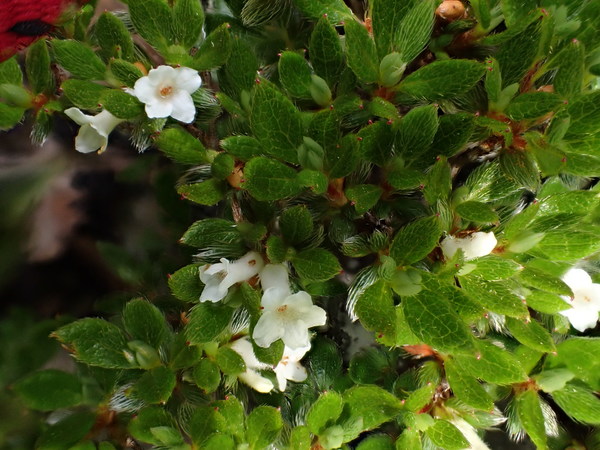
Rhododendron tsusiophyllum ("Hakonekometsutsuji")
Japanese name: ハコネコメツツジ (箱根米躑躅)
Scientific name: Rhododendron tsusiophyllum
[Overview]
A Fossa Magna element plant, a semi-deciduous shrub 0.2–1 m tall, growing on rocky ground and windy grassland in the mountains, centered on the Fuji and Hakone region.
Branches, leaves, calyx and fruit have brown bristles.
It branches densely.
Leaves are simple and alternate, narrowly elliptic, 0.7–1 cm long and 0.4–0.6 cm wide, with a pointed tip, and somewhat thick.
1–3 flowers are borne in an umbel-like arrangement at the branch tips; the corolla is white and tubular, usually shallowly 5-lobed at the tip and opening flat, with dense white hairs on both surfaces.
There are 5 stamens, which do not protrude from the flower.
The fruit is a broadly ovate capsule with 3 chambers.
[Cultivation]
Propagate from seed or by cuttings.
It prefers sunny, well-drained, airy, fertile, acidic soil, but in warm regions a spot in partial shade that avoids the afternoon sun and strong direct sunlight in summer is suitable.
Avoid dry sites, or use mulch or similar to keep the base of the plant from drying out.
For potted plants, from autumn to spring water thoroughly when the soil surface dries, and in midsummer water twice, in the cool of morning and evening, wetting the leaves as well.
For plants in the ground, rainfall is sufficient except in summer; in summer water in the cool of morning or evening, wetting the leaves as well, and in winter, if dry weather continues, water in the morning on a warm day.
In spring and autumn, apply slow-release chemical fertilizer placed on the soil.
Pests and diseases include spider mites and aphids.
Details
Translated from our Japanese encyclopedia. If anything differs, the Japanese page is correct.