
Plant Encyclopedia

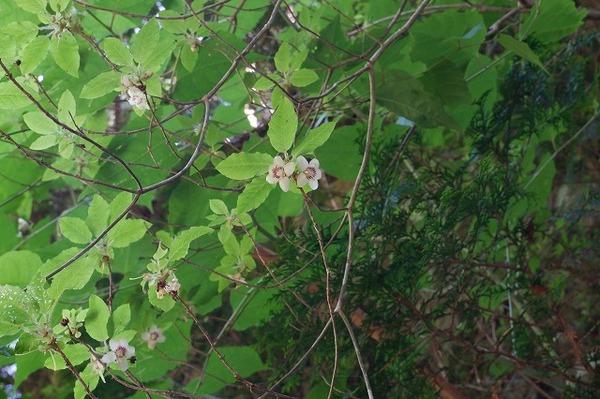
Rhododendron semibarbatum ("Baikatsutsuji")
Japanese name: バイカツツジ (梅花躑躅)
Scientific name: Rhododendron semibarbatum
[Overview]
A deciduous shrub about 2 m tall, found at forest edges in the mountains.
Young branches and petioles have glandular hairs and short hairs.
Leaves are simple and alternate, clustered in whorl-like fashion at the branch tips, elliptic, 2.5–5 cm long and 1–2 cm wide.
The upper surface of the leaf has sparse hairs, and the veins of the underside have glandular hairs.
The petiole is 0.5–1 cm long.
The flowers are 2 cm across and open one at a time from several flower buds below the leaf bud at the branch tip.
The corolla is white with red spots on the upper side, opens widely like a saucer, and is shallowly 5-lobed.
There are 5 stamens.
The fruit is an ovate-globose capsule 4 mm long, with brown glandular hairs.
[Cultivation]
Propagate by cuttings.
It prefers well-drained, fertile, acidic soil.
Avoid dry sites, or use mulch or similar to keep the base of the plant from drying out.
From spring to autumn it is best placed in partial shade out of the afternoon sun and direct summer sunlight, and from autumn to spring in a sunny spot sheltered from cold wind; in the ground, a place shaded by deciduous trees is good.
For potted plants, from autumn to spring water thoroughly when the soil surface dries, and in midsummer water twice, in the cool of morning and evening, wetting the leaves as well.
For plants in the ground, rainfall is sufficient except in summer; in summer water in the cool of morning or evening, wetting the leaves as well, and in winter, if dry weather continues, water in the morning on a warm day.
Apply fertilizer three times in total, in winter, after flowering as a thank-you fertilizer, and in autumn, placing organic fertilizer or a slow-release chemical fertilizer with equal amounts of the three components around the plant.
Pests and diseases include powdery mildew, spider mites, azalea lace bugs and Benimon-aoringa.
[Notes]
The Japanese name likens the shape of the flower to an ume flower.
Details
Translated from our Japanese encyclopedia. If anything differs, the Japanese page is correct.