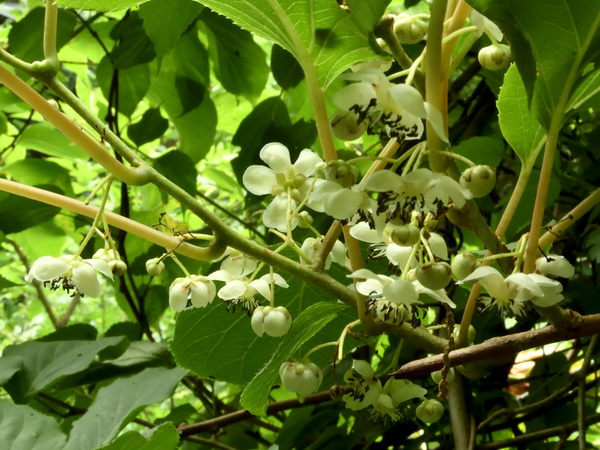
Japanese name: サルナシ(猿梨) Scientific name:Actinidia arguta var. arguta
[Overview]
A deciduous woody vine that twines around other plants and climbs to a height of 30 m.
Young branches have soft brown hairs.
Leaves are simple and alternate, elliptic to broadly ovate, 6–10 cm long and 4–7 cm wide, somewhat thick, with a glossy upper surface.
The leaf margin has fine teeth.
The petiole is 2–8 cm long and often tinged with red.
The plant is dioecious or polygamous.
Cymes arise from the leaf axils in the upper part of young branches, with male flowers in groups of 3–7 and female or bisexual flowers in groups of 1–3.
The flowers are white with 6 petals, 1–1.5 cm across.
The anthers of the stamens are dark purple.
The fruit is an elliptic berry 2–2.5 cm long that ripens to yellowish green.
The flesh is green, and many small black seeds are arranged radially in a ring around the center.
[Uses]
The fruit is eaten fresh, made into fruit liqueur, and also used medicinally.
The vines, which are strong and slow to rot, were used as material for lashing rafts and bridges.
They can also be used to make walking sticks.
[Cultivation]
Propagate by grafting, by cuttings, or from seed.
It prefers a sunny site with good drainage and good water retention.
For potted plants, water thoroughly when the soil surface dries; for plants in the ground, watering is not particularly necessary unless summer brings a long spell of sunny weather and the soil dries out.
Apply organic fertilizer in early spring and autumn.
There are no particular pests or diseases.