
Plant Encyclopedia

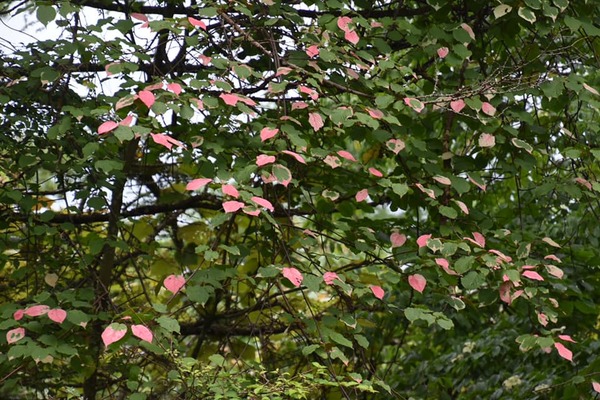
Actinidia kolomikta (variegated-leaf hardy kiwi, "Miyamamatatabi")
Japanese name: ミヤママタタビ (深山木天蓼)
Scientific name: Actinidia kolomikta
[Overview]
A deciduous woody vine found at forest edges in the mountains, climbing by twining around other plants.
It branches freely; the new branches are at first covered with pale brown soft hairs, but later become hairless.
The pith of the branches is ladder-like, with some hollow parts.
Leaves are simple and alternate, 7–12 cm long and 4–8 cm wide, broadly ovate to elliptic, and the base is often indented in a heart shape.
The leaf margins have fine serrations.
Soft or stiff hairs grow on the veins on both surfaces of the leaves.
On flowering branches, the upper half or more of the leaf is white, turning deep pink in the flowering season.
The petiole is 4–7 cm long, often tinged with red, and at first has soft hairs.
It is dioecious.
The flowers are borne in the leaf axils at the base of the new branches; female flowers are usually solitary, and male flowers are borne 1–3 at a time in cymes.
The flowers are white, 1–1.5 cm across, with 4–5 petals.
The fruit is a berry, oblong and 2 cm long, ripening yellowish green.
The seeds are arranged in a ring radiating from the center of the fruit.
[Uses]
The galls are called mokutenryo and are used medicinally.
The fruit is sweet and sour, and is eaten raw or made into fruit liqueur.
[Cultivation]
Propagate by cuttings.
It prefers sun to partial shade and well-ventilated, well-drained, moderately moist soil.
For potted plants, water thoroughly when the soil surface dries; for plants in the ground, rainfall is sufficient.
If fertilizer is applied at planting, no further fertilizing is particularly necessary, but potted plants may be given organic fertilizer in winter.
Pests and diseases include Ameiro-habamodoki.
Details
Japanese: ミヤママタタビ(深山木天蓼)、ウスバシラクチヅル(薄葉白口蔓)
Translated from our Japanese encyclopedia. If anything differs, the Japanese page is correct.