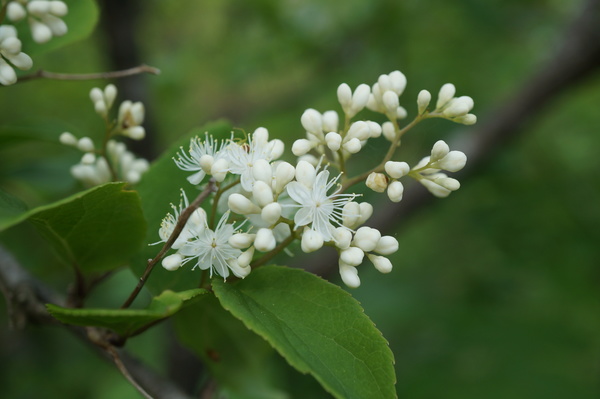
Japanese name: サワフタギ(沢蓋木) Scientific name:Symplocos sawafutagi
[Overview]
A deciduous shrub 2–6 m tall, found along streams and around marshes from lowlands to the mountains.
It branches well, and the bark is grayish white and peels off in thin vertical strips.
Young branches are green and densely hairy.
Leaves are simple and alternate, obovate to elliptic, 3–10 cm long and 2–5 cm wide, with fine serrations on the margin.
The leaves are not glossy and have hairs on the veins of the underside.
Many flowers are borne in panicles at the branch tips.
The corolla is 7–8 mm across, white and deeply 5-lobed, with the lobes spreading flat.
There are many stamens slightly longer than the corolla.
The fruit is a distorted ovate shape, 6–7 mm long, and ripens to a beautiful indigo blue.
Wild birds eat the fruit with relish.
[Uses]
The wood is dense and is used as a substitute for tsuge (boxwood).
The branches and leaves are used as a mordant for dyeing.
[Notes]
The Japanese name is said to come from the way it grows thickly enough to hide a stream.