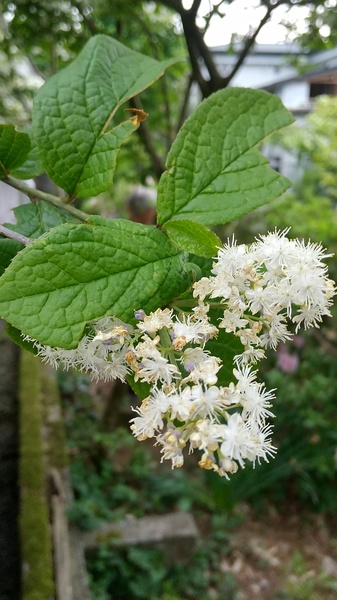
Japanese name: タンナサワフタギ(耽羅沢蓋木) Scientific name:Symplocos coreana
[Overview]
A deciduous shrub or small tree 3–5 m tall, found on ridges and forest edges in the mountains.
It branches freely, and the bark is grayish white, splitting lengthwise and gradually peeling off in thin pieces.
Young branches are green and usually become hairless.
Leaves are simple and alternate, ovate to obovate, 4–8 cm long and 2–5 cm wide, with the tip abruptly drawn out into a tail and sharp, coarse serrations on the margin.
The leaves are not glossy and have hairs along the veins on the underside.
Many flowers are borne in panicles 4–8 cm long at the branch tips.
The corolla is white, 0.8–0.9 cm across, and deeply divided into 5 lobes that spread flat.
There are many stamens slightly longer than the corolla.
The fruit is a lopsided ovoid, 0.6–0.7 cm long, ripening to indigo-black.