EVERGREEN

Plant Encyclopedia

Phlox paniculata

Phlox paniculata (fall phlox, "Kusakyochikuto")

Japanese name: クサキョウチクトウ (草夾竹桃)
Scientific name: Phlox paniculata

Phlox paniculata

[Overview]
A perennial 60–120 cm tall.
The stem is erect.
Leaves are simple, decussate-opposite or in whorls of 3, lanceolate, 7–13 cm long, with entire margins.
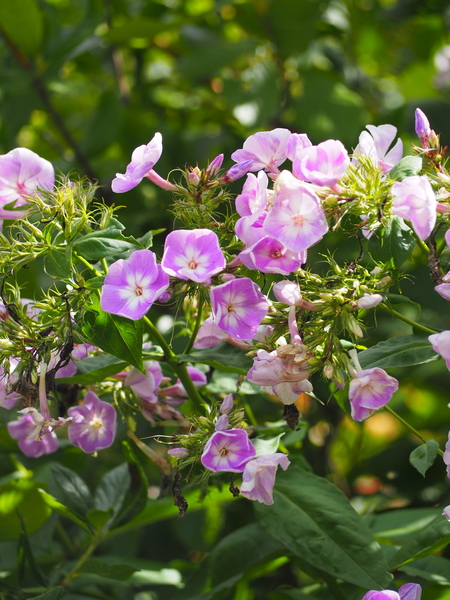
Panicles at the stem tips bear many flowers about 2.5 cm across.
The corolla is 5-lobed and opens flat.
Flower color in wild plants is white to pale reddish purple, but cultivars come in a wide variety of colors.

[Uses]
The leaves are used medicinally.

[Cultivation]
Propagate from seed, by division, or by root cuttings.
It prefers fertile soil with sun and good drainage.
For potted plants, water thoroughly when the soil surface dries; for plants in the ground, rainfall is sufficient.
For potted plants, apply slow-release fertilizer in spring and autumn.
Pests and diseases include powdery mildew and cutworms.

Details

Names
English: fall phlox, garden phlox, perennial phlox, summer phlox
Japanese: クサキョウチクトウ(草夾竹桃)、オイランソウ(花魁草)、宿根フロックス
Life form
Perennial
Habit
Terrestrial
Planting (or sowing) season
March, April, May
Flowering season
June, July, August, September
Distribution or origin
North America
Height
600–1200 mm
Leaf shape
Simple leaf (unlobed)
Leaf arrangement
Opposite, Whorled
Leaf margin
Entire
Inflorescence
Panicle
Flower color
Red, Purple, Pink, White, Multicolor
Flower diameter
25
Leaf color
Green
Availability of seeds and plants
Low
Form sold
Seeds, Seedlings
Propagation
Seed, Division
Sun exposure
Full sun
Water needs
Moderate
Soil needs
Required
Tolerance
Cold tolerance
Suitable uses
Potted plant, Flower bed, Parks and gardens, Container
Diseases
Powdery mildew
Pests
Armyworms
Uses
Medicinal
Japan Flower Trade Code
22133

Translated from our Japanese encyclopedia. If anything differs, the Japanese page is correct.

Sponsored