
Plant Encyclopedia

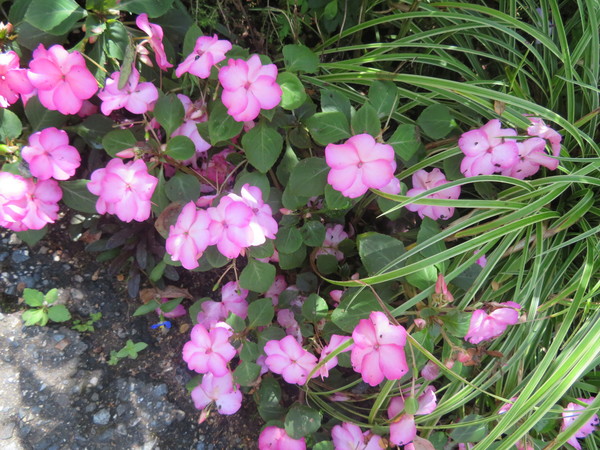
Impatiens walleriana (busy Lizzie, "Afurikahosenka")
Japanese name: アフリカホウセンカ
Scientific name: Impatiens walleriana
[Overview]
A perennial 30–60 cm tall.
In horticulture it is often treated as an annual.
The stems and leaves are soft and succulent, and branch well.
Leaves are simple and alternate, ovate to elliptic, 2.5–13 cm long, with rounded teeth on the margin and awn-like projections between the teeth.
The petioles are long.
Racemes arise from the upper leaf axils of the stem and bear 1–3 flowers.
The flowers are 2.5–5 cm across and open flat.
They have a spur 3–5 cm long.
Many cultivars have been bred, with flower colors including red, orange, pink, white and bicolors.
Some have double flowers, and some have leaves with white or yellow variegation.
When a ripe fruit is touched, it splits open and the seeds scatter.
The surface of the seeds has countless hair-like projections.
[Cultivation]
Propagate by cuttings.
It grows even in shade, but prefers a place with sun and good drainage and moisture retention.
It dislikes dryness.
It is not cold-hardy and is therefore treated as an annual, but it can overwinter if kept indoors in a warm, sunny place in winter.
Water when the soil surface dries. In summer, avoid watering during the day and water in the morning or evening.
It likes fertilizer, so in addition to base fertilizer, apply additional fertilizer during the flowering period.
Faded flowers left on the plant can cause disease, so remove them frequently.
Pests and diseases include gray mold, spider mites, thrips and aphids.
Details
Japanese: アフリカホウセンカ、インパチェンス、インパチエンス
Translated from our Japanese encyclopedia. If anything differs, the Japanese page is correct.