
Plant Encyclopedia

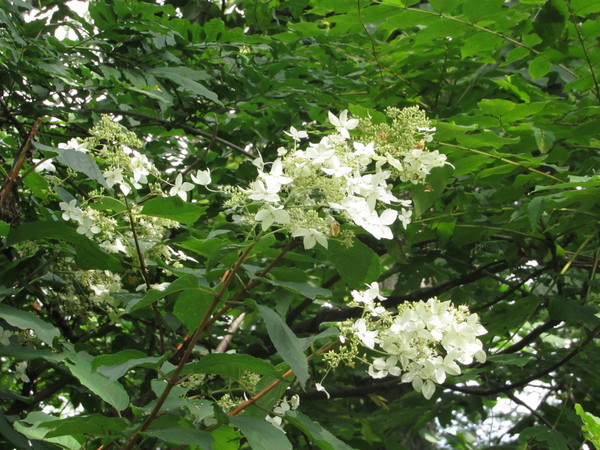
Hydrangea paniculata ("Noriutsugi")
Japanese name: ノリウツギ (糊空木)
Scientific name: Hydrangea paniculata
[Overview]
A deciduous shrub to small tree growing up to 5 m tall.
The inner bark contains mucilage.
The leaves are simple and opposite, elliptic, 5–15 cm long and 3–8 cm wide, with teeth on the margin.
A paniculate corymb 8–30 cm long is produced at the branch tips.
The inflorescence has white, 4-petaled ornamental flowers around the edge, and many white bisexual flowers in the center.
The ornamental flowers change to pale red to pale green in the fruiting season.
The bisexual flowers have 5 petals and 10 stamens of the same color as the petals.
The fruit is a capsule 4–5 mm long.
[Uses]
The mucilage was used as a paste when making washi (Japanese paper).
The wood is used for kanjiki (snowshoes), walking sticks, wooden pegs and the like, and pipes are made from the roots.
[Cultivation]
Propagate by division, cuttings or layering.
It prefers sun to partial shade and fertile, well-drained soil.
It is unsuitable for places where the soil becomes extremely dry or where strong afternoon sun falls.
It is easy to grow, vigorous, and flowers well every year.
For potted plants and for plants in the ground for less than 2 years, water thoroughly when the soil surface dries.
Watering is not particularly necessary for established plants in the ground, but if the soil dries out in the high temperatures of summer, water in the morning or evening when the temperature is lower.
In addition to basal fertilizer, apply slow-release fertilizer around the base of the plant in winter.
There are no particular pests or diseases.
Details
Translated from our Japanese encyclopedia. If anything differs, the Japanese page is correct.