
Plant Encyclopedia

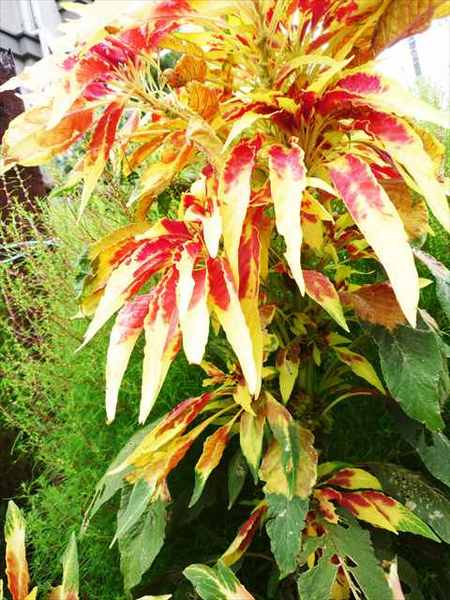
Amaranthus tricolor var. tricolor (edible amaranth, "Hageito")
Japanese name: ハゲイトウ (葉鶏頭)
Scientific name: Amaranthus tricolor var. tricolor
[Overview]
An annual 80–150 cm tall.
The stem is erect and thick.
Leaves are simple and alternate, elliptic to linear, 5–20 cm long and 2–7 cm wide.
The leaf margin is entire.
The leaves are green at first, but from around August the leaves at the stem tips turn three colors, yellow, red and green, or four colors, yellow, red, purplish red and green, and the colors are most vivid in autumn.
There are horticultural varieties with various leaf colors.
The flowers arise from the leaf axils and are small and inconspicuous.
[History]
It was introduced to Japan during the Meiji period.
[Cultivation]
Propagate from seed.
The optimum temperatures for germination are 16°C at night and 26°C during the day.
It dislikes being transplanted, so sow directly where you want it to grow and thin out the seedlings, or sow in plastic pots and transplant when 3–5 true leaves have appeared.
It prefers fertile soil in a sunny, well-drained site.
If the environment suits it, it can be grown easily without any special effort.
Rainfall is sufficient for watering.
Fertilizer is not particularly necessary.
As the plant grows taller it falls over easily, so set up supports.
There are no particular pests or diseases, but growing it repeatedly in the same place makes damping-off more likely.
Details
Japanese: ハゲイトウ(葉鶏頭)
Translated from our Japanese encyclopedia. If anything differs, the Japanese page is correct.