
Plant Encyclopedia

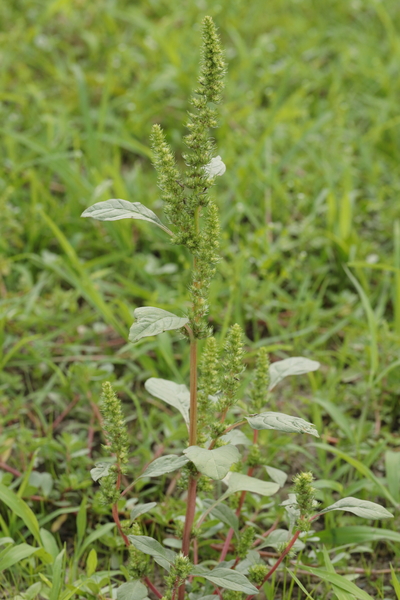
Amaranthus hybridus (green amaranth, "Hosoaogeito")
Japanese name: ホソアオゲイトウ (細青鶏頭)
Scientific name: Amaranthus hybridus
[Overview]
An annual 1–2 m tall.
It grows in colonies on wasteland, in fields, along roadsides and on riverbanks.
The stem is erect and branched, often tinged reddish purple, with soft hairs in the upper part.
Leaves are simple and alternate, rhombic-ovate, 5–12 cm long, with a pointed tip; the upper surface is almost hairless and dull, and the veins on the underside have soft hairs.
The leaf margin is entire.
The petioles are long.
In the lower part of the stem the inflorescences arise from the leaf axils, while in the upper part spike-like inflorescences gather into a narrow panicle.
The branches of the inflorescence are short, dense, and point obliquely upward.
The flowers are male or female, with 5 tepals.
The bracts are about 1.5 times as long as the tepals and end in a short awn.
The fruit is a utricle, which when ripe splits crosswise so that the lid comes off.
[History]
It arrived in Japan between the end of the Meiji period and the early Taisho period, and has become naturalized in many areas.
Details
Japanese: ホソアオゲイトウ(細青鶏頭)、ムラサキアオゲイトウ(紫青鶏頭)
Translated from our Japanese encyclopedia. If anything differs, the Japanese page is correct.