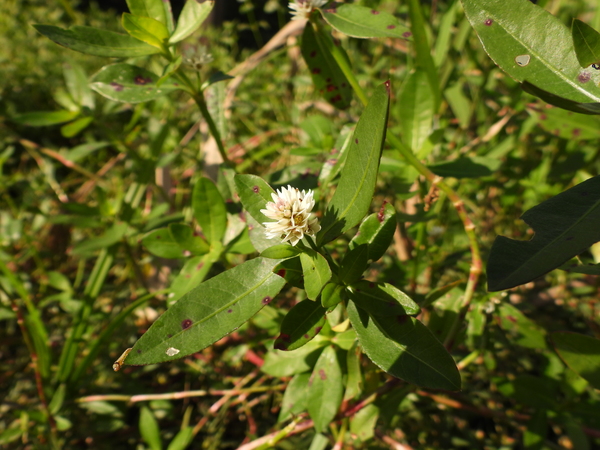
Japanese name: ナガエツルノゲイトウ(長柄蔓野鶏頭) Scientific name:Alternanthera philoxeroides
[Overview]
A perennial found in wetlands along waterways and rivers.
The stem is hollow and branches freely from the base; it either creeps along the ground, rooting at the nodes, or rises obliquely, reaching 50–100 cm in length.
Leaves are simple and opposite, obovate to lanceolate, 2.5–5 cm long and 0.7–2 cm wide.
The leaf margins have fine teeth.
There is no petiole, or it is 0.1–0.6 cm long.
At the tip of a stalk 1–4 cm long arising from the leaf axils in the upper part of the stem, a spherical inflorescence 1.2–1.6 cm across bears a cluster of about 20 flowers.
The flowers are white to grayish white with 5 petals, and the petals are dry and membranous.
The fruit is a utricle.
[History]
It was first recorded in 1989 in Amagasaki, Hyogo, and it has become widely naturalized from the Kanto region southward.
[Notes]
It is designated an "Invasive Alien Species" under the Invasive Alien Species Act.