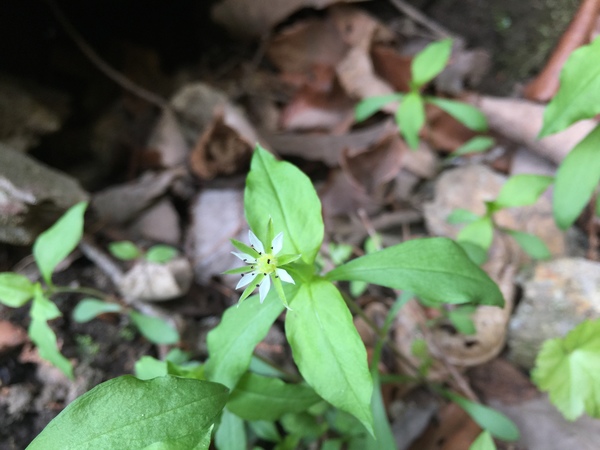
Japanese name: ヒゲネワチガイソウ(髭根輪違草) Scientific name:Pseudostellaria palibiniana
[Overview]
A perennial 10–20 cm tall, found in deciduous forests from hills to mountains.
1–4 roots are produced, thickened into a spindle shape and fleshy; there are also fibrous roots.
The stem is erect and unbranched, with two rows of short hairs.
The leaves are simple and opposite, but the upper two pairs sit close together and appear to be whorled.
The upper leaves are broadly elliptic to broadly ovate, 4.5–8 cm long and 1.8–3 cm wide; the lower leaves are linear-spatulate, 2–5 cm long and 0.3–1.3 cm wide.
Hairs grow only at the base of the leaf, and the leaf margin is wavy.
The flowers are borne singly in the axils of the upper leaves and are white, 5-petaled (sometimes 6–7-petaled) and 1 cm across.
The petal tips are pointed.
The flower stalk is 2–2.5 cm long and hairless.
There are 10 stamens (sometimes 12–14), and the anthers are dark reddish brown.
Cleistogamous flowers are borne in the axils of the lower leaves.
The fruit is an ovate capsule.