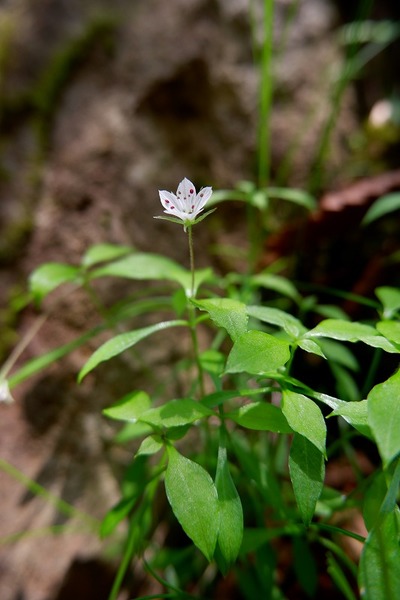
Pseudostellaria heterantha var. heterantha("Wachigaiso")
Japanese name: ワチガイソウ(輪違草) Scientific name:Pseudostellaria heterantha var. heterantha
[Overview]
A perennial 7–15 cm tall, found in deciduous forests in the mountains.
1–2 roots are produced; they are thickened into a spindle shape and fleshy.
The stem is erect, with 1–2 rows of short hairs.
The leaves are simple and opposite, 1–5 cm long and 0.4–1.5 cm wide; the leaves on the lower part of the stem are linear-spatulate to oblanceolate, and those on the upper part are ovate to long ovate.
The leaf base gradually narrows into a leaf stalk, and the margin at the base is hairy.
The flowers are solitary in the leaf axils of the upper stem, white, 5-petaled (occasionally 4-petaled), 1 cm across.
The flower stalks are 1–5 cm long and have downward-curved hairs.
There are 10 stamens, and the anthers are dark reddish brown.
A few cleistogamous flowers are borne in the leaf axils on the lower part of the stem.
The fruit is an ovate capsule.
[Notes]
According to Makino Tomitaro, the Japanese name originated when, the name of this plant being unknown, a wachigai (interlocking rings) mark was attached to a bonsai as a sign that it was unnamed.