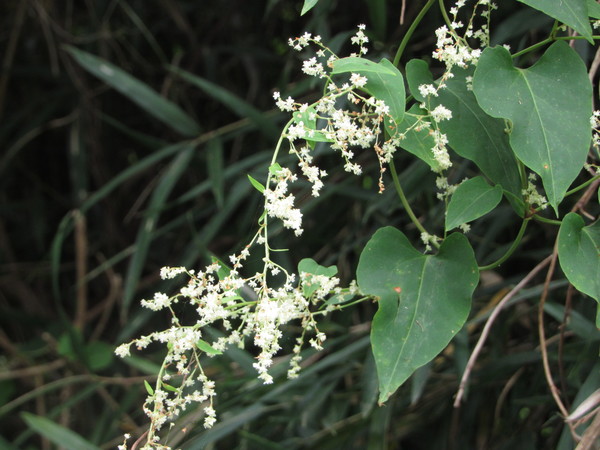
Japanese name: ツルドクダミ(蔓蕺、蔓蕺菜) Scientific name:Fallopia multiflora
[Overview]
A climbing perennial.
It has tubers underground.
The stems grow 1–3 m long, branch well and twine around other objects, and become woody at the base.
Leaves are simple and alternate, ovate-cordate, 3–6.5 cm long, with a pointed tip.
The leaf margins are entire.
The leaf stalk is shorter than the leaf blade.
There is a short, tubular, membranous ocrea.
There is a joint at the base of the leaf stalk.
Paniculate pseudoracemes arising in the leaf axils and at the stem tips bear many flowers.
The flowers are small, about 2 mm long, with no petals and a white or red calyx.
The three outer calyx lobes enlarge into wings after flowering and enclose the fruit.
The fruit is an achene.
[History]
Plants introduced in the Edo period as a medicinal plant have escaped and become naturalized in various places.