
Plant Encyclopedia

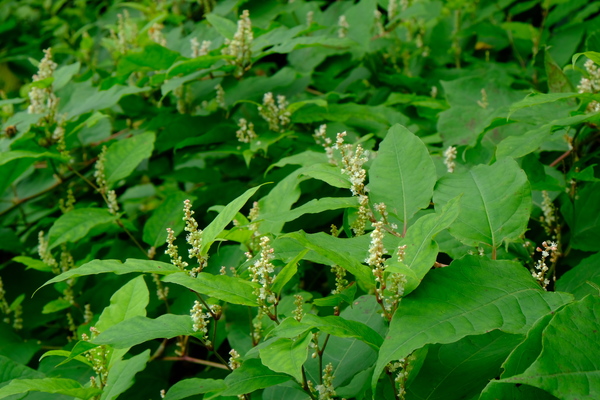
Fallopia japonica var. japonica (Asian knotweed, "Itadori")
Japanese name: イタドリ (虎杖、痛取)
Scientific name: Fallopia japonica var. japonica
[Overview]
A perennial 30–150 cm tall that prefers slightly moist places such as sunny wasteland and roadsides.
It is also a pioneer plant, the first to grow in places such as collapsed slopes.
A thick rhizome develops, and it often forms colonies.
The stems come up in clumps, erect or ascending, and branch well in the upper part.
The stems are hollow with many nodes.
The nodes of the stems and the new shoots are tinged with red.
Leaves are simple and alternate, triangular-elliptic to broadly ovate, 6–15 cm long and 5–9 cm wide, with an abruptly pointed tip.
The leaf margins are entire.
There is a leaf stalk.
It is dioecious.
Both male and female plants produce racemes gathered in panicles at the stem tips and in the leaf axils, bearing many densely set flowers.
The flowers have no petals; the white calyx, divided into 5 lobes, is conspicuous.
In the male flowers, 8 stamens extend long.
The fruit is an achene with 3 ridges and 3 wings.
[Uses]
The young stems are used as a wild vegetable.
The rhizomes and young leaves are used medicinally.
It is a nectar source plant.
In the past the young leaves were used as a substitute for tobacco.
[Cultivation]
Propagate by division.
It prefers a sunny, well-drained place.
Cultivation is easy.
Details
Japanese: イタドリ(虎杖、痛取)、オノエイタドリ(尾上虎杖)、サイタヅマ、タチヒ
Translated from our Japanese encyclopedia. If anything differs, the Japanese page is correct.