
Plant Encyclopedia

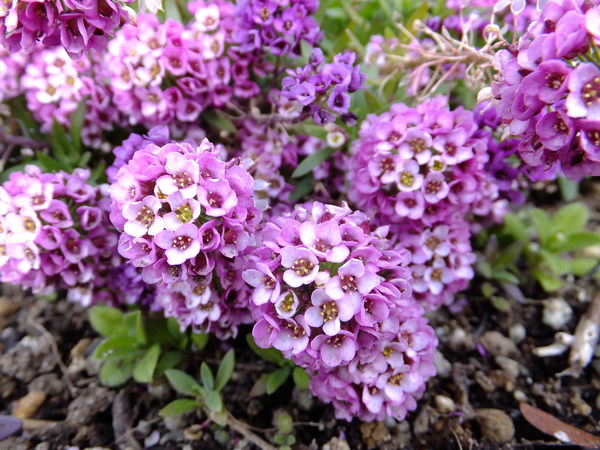
Lobularia maritima (sweet alyssum, "Niwanazuna")
Japanese name: ニワナズナ (庭薺)
Scientific name: Lobularia maritima
[Overview]
A perennial that grows in colonies on sunny, dry sandy ground and similar places in its native range, reaching 5–30 cm in height and 20–30 cm in width.
It dislikes heat and humidity, so in Japan it is treated as an annual.
The stems branch well from the base and form a hemispherical clump.
The leaves are alternate, linear to lanceolate, densely hairy, with entire margins.
A corymb or raceme at the stem tip is at first compact and hemispherical, but elongates at the fruiting stage.
The flowers are four-petaled and fragrant.
[Cultivation]
Propagate from seed or by cuttings of shoots.
The optimum germination temperature is 15°C; sow in autumn in warm regions and in spring in cold regions.
It prefers a sunny soil that is well drained, moisture-retentive and well aerated.
It dislikes acidic soil.
Frost damages the plant, so frost protection is necessary.
It dislikes heat and humidity, so if you want it to survive the summer, cut it back to near the base around the rainy season.
It does better slightly on the dry side; water thoroughly when the soil dries.
Apply slow-release fertilizer as a base fertilizer, and during flowering apply diluted liquid fertilizer once every 1–2 weeks.
If cut back to about 1/3 of its height after the spring flowering, a second flush of flowers can be enjoyed.
Pests and diseases include sclerotinia rot and aphids.
Details
Japanese: ニワナズナ(庭薺)、アリッスム、アリッサム、スイートアリッサム
Translated from our Japanese encyclopedia. If anything differs, the Japanese page is correct.