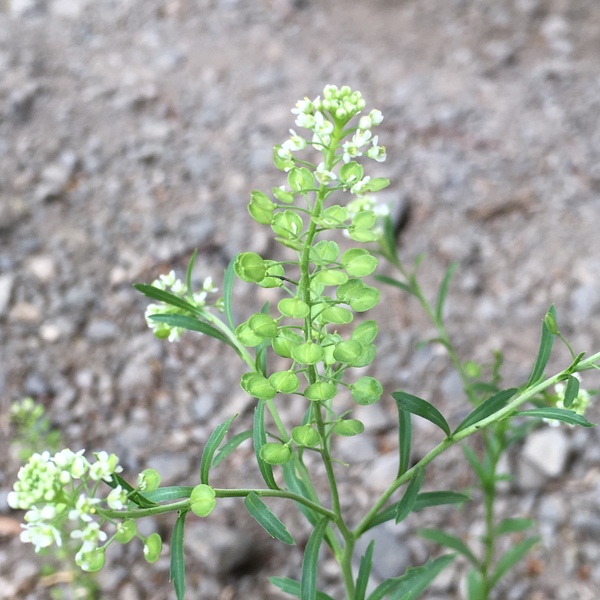
Japanese name: マメグンバイナズナ(豆軍配薺) Scientific name:Lepidium virginicum
[Overview]
An annual or biennial 10–60 cm tall, found along roadsides and on waste ground.
The stem branches in the upper part and bears curved hairs.
There are basal leaves and stem leaves; the basal leaves are 5–15 cm long and 1–5 cm wide, glossy, and divided in a pinnate pattern with a large terminal lobe.
The leaves on the stem are simple and alternate, lanceolate, with teeth on the margin, though sometimes entire.
A raceme at the stem tip bears many white four-petaled flowers about 3 mm across.
The fruit is 2.5–4 mm long, flat and round like a gunbai (war fan), divided into two chambers left and right, with one seed in each chamber.
[History]
It is said to have become naturalized in the middle of the Meiji period.
[Cultivation]
Propagate from seed.
It prefers a sunny, well-drained soil.
For potted plants, water thoroughly when the soil surface dries; for plants in the ground, rainfall is sufficient.
Fertilizer is not particularly necessary.
There are no particular pests or diseases.