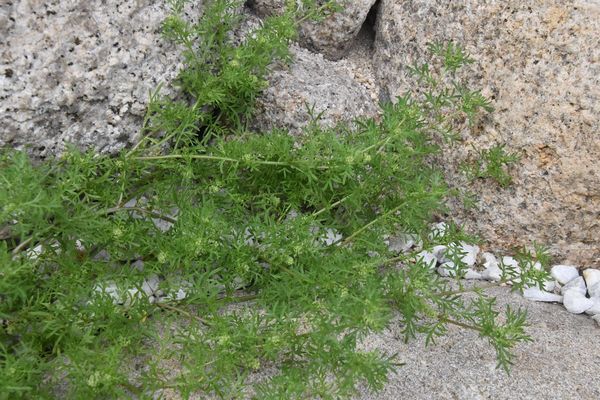
Japanese name: カラクサナズナ(唐草薺) Scientific name:Lepidium didymum
[Overview]
An annual or biennial 10–20 cm tall with an unpleasant odor, found in fields and along roadsides.
The stems branch well from the base and spread; they are pale green and slightly glossy, and are either hairless or sparsely covered with white hairs.
There are basal leaves and alternate leaves on the stem, which are deeply pinnately divided once or twice, with 3–7 pairs of lateral lobes.
The inflorescence is a small raceme arising from the base or opposite the stem leaves; the flowers are white to pale yellow, four-petaled, about 1 mm across, though the petals are sometimes reduced.
The fruit is 1.5 mm high and 2–3 mm wide, shaped like flattened spheres joined side by side, with a fine net-like pattern of depressions on the surface and one seed in each chamber.
The fruit does not split open even when ripe.
[History]
It was recorded in the Ogasawara Islands around 1899 (Meiji 32) and has become naturalized in various places.
[Notes]
It is a problem because when dairy cows eat this plant, the unpleasant odor is transferred to the milk.