
Plant Encyclopedia

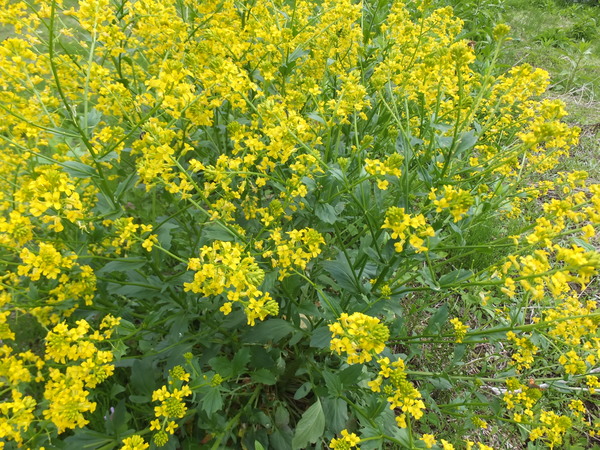
Barbarea vulgaris (bittercress, "Haruzakiyamagarashi")
Japanese name: ハルザキヤマガラシ (春咲山芥子)
Scientific name: Barbarea vulgaris
[Overview]
A biennial or short-lived perennial about 20–90 cm tall.
It is naturalized throughout Japan, but is especially common from the Chubu region northward, where it often forms large colonies in pastures, fields and roadsides.
The stem is erect and branches freely in the upper part, giving the plant a broom-like form.
The basal leaves have petioles and are pinnately divided to the midrib, with 2–4 pairs of lateral leaflets.
The upper stem leaves are alternate and sessile, pinnately lobed deeply to shallowly, and their bases clasp the stem.
The leaves are rather thick and glossy.
The flowers are borne in racemes at the stem tips and are bright yellow with 4 petals.
The flowers are 6–8 mm across.
The style is about as long as the ovary, which distinguishes it from Yama-garashi, whose style is shorter than the ovary.
The fruit is 1.5–3 cm long and somewhat square in cross-section, with the seeds lined up in a single row inside.
The beak of the fruit is 1.8–3 mm long and longer than it is wide, which distinguishes it from Yama-garashi, whose beak is as long as it is wide.
[History]
It was introduced in the late Meiji period and grown in botanical gardens.
It spreads by seeds and rhizomes, and is thought to have become naturalized after the war, having been mixed in with wheat and barley.
Details
Japanese: ハルザキヤマガラシ(春咲山芥子)、フユガラシ(冬芥子)
Translated from our Japanese encyclopedia. If anything differs, the Japanese page is correct.