
Plant Encyclopedia

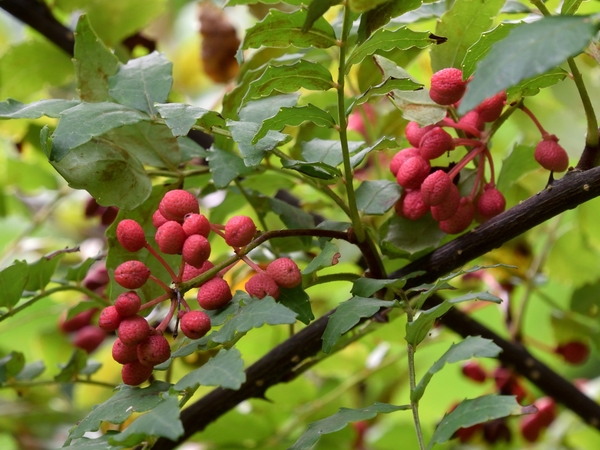
Zanthoxylum piperitum (Japanese pepper, "Sansho")
Japanese name: サンショウ (山椒)
Scientific name: Zanthoxylum piperitum
[Overview]
A deciduous shrub 1.5–3 m tall, found in moist forests in low mountains and often planted in gardens.
The leaves are alternate, odd-pinnately compound, 5–18 cm long, and consist of 9–19 leaflets.
The leaflets are ovate to ovate-elliptic, 1–5 cm long and 0.5–2 cm wide, with coarse teeth on the margin.
The branches near the leaf base usually bear a pair of sharp spines.
It is dioecious.
Both male and female flowers are borne in large numbers in short panicles 1–3 cm long at the branch tips.
The flowers have 7–8 tepals with no distinction between sepals and petals.
The fruit consists of 1–3 segments, each one a red, wrinkled, elliptic-spherical body about 5 mm across.
When ripe, the fruit splits open to reveal black seeds.
[Uses]
The young leaves, fruit, fruit skin and flowers are used as a spice; the young leaves are called "kinome" and the flowers "hana-zansho".
The fruit skin is used medicinally.
The wood is made into pestles.
[Cultivation]
Propagate from seed or by grafting.
Plants grown from seed will include both males and females.
It prefers fertile, well-drained soil in sun to partial shade.
Strong direct sunlight in summer can cause leaf scorch.
Avoid dry places and places exposed to strong afternoon sun.
For potted plants, water thoroughly when the soil surface dries; for plants in the ground, rainfall is sufficient unless sunny weather continues and the soil dries out.
Apply organic fertilizer in winter, and if the leaves or fruit are harvested, apply additional fertilizer in autumn.
Pests and diseases include southern blight and the larvae of swallowtail butterflies.
[Notes]
In China, the kasho used as a spice in Sichuan cuisine and elsewhere is a different species called Kahoku-zansho.
Details
Japanese: サンショウ(山椒)、アツカワザンショウ(厚皮山椒)、イボザンショウ(疣山椒)、ハジカミ(椒)
Translated from our Japanese encyclopedia. If anything differs, the Japanese page is correct.