
Plant Encyclopedia

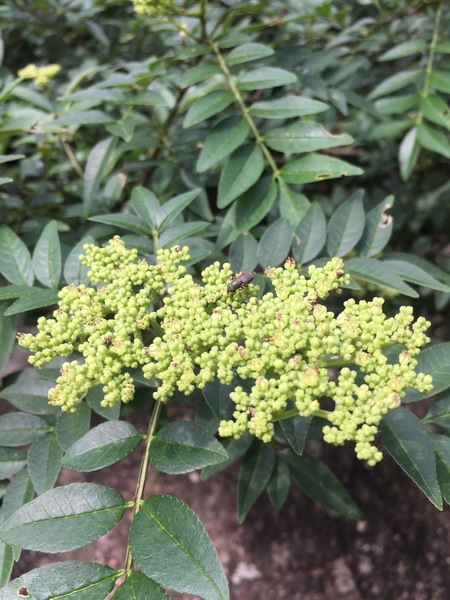
Zanthoxylum schinifolium var. schinifolium (mastic-leaf prickly ash, "Inuzansho")
Japanese name: イヌザンショウ (犬山椒)
Scientific name: Zanthoxylum schinifolium var. schinifolium
[Overview]
A deciduous shrub 1.5–4 m tall, found in forests and on logged sites.
Young branches are hairless.
The branches bear alternate spines 0.4–1 cm long, flattened and broadened at the base.
The leaves are alternate, odd-pinnately compound, 5–15 cm long, and consist of 11–23 leaflets.
The leaflets are lanceolate to elliptic, 1–4 cm long and 0.5–1.5 cm wide, with fine blunt teeth on the margin.
It is dioecious.
Both male and female flowers are borne in large numbers in corymbs at the branch tips; they are small, white and 5-petaled.
The fruit consists of 3 segments, each one an oblate sphere 5 mm long that splits open when ripe to reveal black seeds.
[Uses]
The fruit is used medicinally.
[Cultivation]
Propagate from seed or by grafting.
Plants grown from seed will include both males and females.
It grows well in any soil as long as the site is sunny and well drained.
It tolerates partial shade.
For potted plants, water thoroughly when the soil surface dries; for plants in the ground, rainfall is sufficient unless sunny weather continues and the soil dries out.
Apply organic fertilizer in winter.
Pests and diseases include the larvae of swallowtail butterflies.
[Notes]
The Japanese name comes from the fact that it resembles sansho but its leaves have an inferior fragrance.
Details
Japanese: イヌザンショウ(犬山椒)、オオバイヌザンショウ(大葉犬山椒)、ホソバイヌザンショウ(細葉犬山椒)、コバノイヌザンショウ(小葉犬山椒)
Translated from our Japanese encyclopedia. If anything differs, the Japanese page is correct.