
Plant Encyclopedia

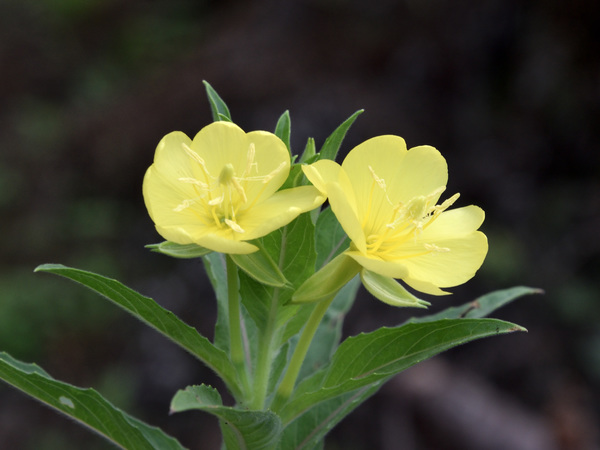
Oenothera biennis (common evening-primrose, "Mematsuyoigusa")
Japanese name: メマツヨイグサ (女待宵草、雌待宵草)
Scientific name: Oenothera biennis
[Overview]
A biennial 30–200 cm tall, found along roadsides, on waste ground and on riverbanks.
The whole plant bears upward-pointing, flattened hairs.
The stem is erect and sometimes branches in the upper part.
It germinates in autumn and overwinters as a rosette.
There are basal leaves and stem leaves; the basal leaves have petioles, many teeth, are not wavy, and have pointed tips.
The stem leaves are simple and alternate, ovate to oblong-lanceolate, 5–22 cm long and 1.5–5 cm wide, and the midrib is often tinged with red.
The leaf margins have low teeth.
The flowers are borne in spikes at the stem tips and are yellow, four-petaled, and about 2.5–5 cm across.
They open in the evening and wilt by the next day.
The calyx is yellowish green and not tinged with red.
The fruit is an oblong capsule 2–4 cm long.
It resembles Omatsuyoigusa, but can be distinguished by the characteristics of the basal leaves, the color of the leaf midrib, the color of the calyx, and so on.
[History]
It is said to have arrived in Japan in the 1920s.
[Notes]
It is designated as an Invasive Alien Species Requiring Attention under the Invasive Alien Species Act.
Details
Japanese: メマツヨイグサ(女待宵草、雌待宵草)
Translated from our Japanese encyclopedia. If anything differs, the Japanese page is correct.