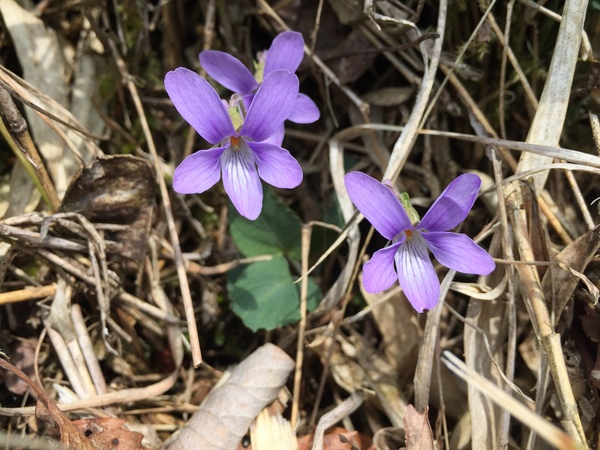
Japanese name: コスミレ(小菫) Scientific name:Viola japonica
[Overview]
A perennial found along roadsides and on banks near houses and cultivated land.
It has no aboveground stem.
The leaves have long petioles and grow from the base; they are 2–6 cm long, slightly rounded, triangular to long-ovate, with low serrations on the margins.
The upper side of the leaf is tinged white as if dusted with powder, and the underside may be tinged purple.
The leaves are broader than those of the sumire (violet).
The flowers are borne at the tips of upright flower stalks from the leaf axils; they are 1.5–2 cm across and pale purple, with the center of the lip petal white with purple streaks.
A slender spur 6–8 mm long extends behind the flower.
Each plant bears many flowers, and some bloom so profusely that the whole plant is covered with flowers.
Flower color varies, the hairs at the base of the lateral petals are present in some and absent in others, and the hairs on the leaves and flower stalks range from hairless to hairy all over.
Summer flowers are cleistogamous.
The fruit is a capsule that splits into 3 when ripe and scatters the seeds.
[Cultivation]
Propagate from seed, by stem cuttings, or by division.
It prefers partial shade and well-drained soil rich in humus.
It is easy to grow, but powdery mildew may occur.
Pests include aphids, spider mites, cutworms and the Indian fritillary (Tsumaguro-hyomon).