
Plant Encyclopedia

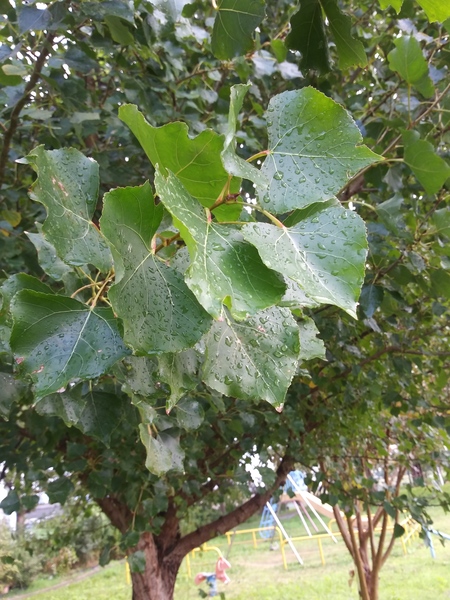
Populus nigra var. italica (Lombardy poplar, "Seiyohakoyanagi")
Japanese name: セイヨウハコヤナギ (西洋箱柳)
Scientific name: Populus nigra var. italica
[Overview]
A deciduous tree growing as tall as 30 m.
It grows fast, and its branches extend upward almost parallel to the trunk, giving a very slender crown.
The roots spread shallowly and widely.
The bark is deeply furrowed lengthwise.
The leaves are simple and alternate, broadly triangular or slightly rhombic-triangular, 5–10 cm long, and hairless on both sides.
The leaf margins have fine teeth.
The petiole is 2–7 cm long and flattened in cross section.
The leaves turn yellow in autumn.
Usually only male trees exist, and the male flowers form catkins.
[History]
It is thought to have arisen in the late 17th century in Lombardy in northern Italy, as a mutation of a male Yoroppa-kuroyamanarashi (Populus nigra).
Usually only male trees exist, but female trees occasionally appear.
Like Yoroppa-kuroyamanarashi, female trees have branches that spread sideways and form a broad crown.
[Uses]
The bark and leaves are used medicinally.
The wood is light and soft and is used for matchsticks, pulp and other purposes.
[Cultivation]
Propagate by cuttings.
It prefers fertile, well-drained soil with moderate moisture, but as long as the site is sunny it grows well without being particular about soil type.
It suits cool regions; because its roots are shallow and it is easily toppled by strong winds, it is unsuited to windy places and to regions with many typhoons.
Fallen leaves and twigs must be cleaned up frequently.
Pests and diseases include Cytospora canker, dieback, rust, powdery mildew, aphids and scale insects.
Details
Japanese: セイヨウハコヤナギ(西洋箱柳)、ポプラ、イタリアポプラ、イタリアヤマナラシ、ピラミッドヤマナラシ、ロンバルディポプラ
Translated from our Japanese encyclopedia. If anything differs, the Japanese page is correct.