
Plant Encyclopedia

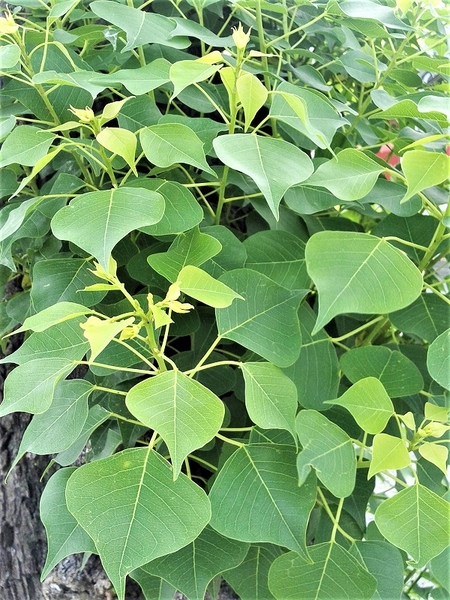
Triadica sebifera (Chinese tallow, "Nankinhaze")
Japanese name: ナンキンハゼ (南京櫨、南京黄櫨)
Scientific name: Triadica sebifera
[Overview]
A deciduous tree about 15 m tall and 35 cm in trunk diameter.
White latex exudes when the plant is injured.
The bark splits irregularly lengthwise.
Young branches are green at first.
The leaves are simple and alternate, rhombic-ovate, 3.5–7 cm long, with a long tail-like tip.
The leaf margin is entire.
The petiole is 2–8 cm long and has 2 glandular spots at the junction with the leaf.
The leaves turn red in autumn.
There are male and female flowers.
Racemes 6–18 cm long are produced at the branch tips, bearing many male flowers in the upper part and 1–3 female flowers in the lower part, though sometimes no female flowers are borne.
Neither male nor female flowers have petals.
The male flowers have stalks 1.5–3 mm long; the calyx is saucer-shaped and shallowly 3-lobed, and there are 2 stamens.
The female flowers have stalks 2.5–3 mm long; the calyx is 3-lobed and there are 3 styles.
The fruit is an oblate capsule about 1.5 cm across with 3 rounded ridges, and it splits open when ripe.
The seeds are ovoid and enclosed in a white, waxy aril.
[Uses]
Though toxic, the fat from the seeds is used as a raw material for soap and candles, and the root bark and fruit are used medicinally.
The wood is also used for furniture and utensils.
[Cultivation]
Propagate from seed.
Warm regions west of Kanto are suitable for planting.
It grows well in any soil as long as the site is sunny and well drained.
For potted plants, water thoroughly when the soil surface dries; for plants in the ground, rainfall is sufficient.
Apply organic fertilizer in winter.
There are no particular pests or diseases.
Details
Japanese: ナンキンハゼ(南京櫨、南京黄櫨)
Translated from our Japanese encyclopedia. If anything differs, the Japanese page is correct.