
Plant Encyclopedia

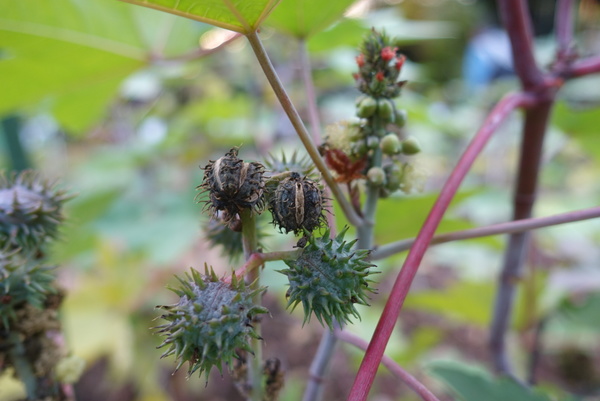
Ricinus communis (castor bean, "Togoma")
Japanese name: トウゴマ (唐胡麻)
Scientific name: Ricinus communis
[Overview]
In the tropics it is a shrub about 10 m tall, but in temperate regions it is treated as an annual or perennial about 4–5 m tall.
The whole plant is often tinged red to purple, and the stem is erect.
Young stems are covered with a whitish bloom.
The leaves are alternate, palmately divided into 5–11 lobes, up to about 90 cm across, with toothed margins.
They have long petioles.
Panicles are produced at the stem tips.
There are male and female flowers, with the female flowers in the upper part of the inflorescence and the male flowers in the lower part; neither has petals.
The fruit is a spherical to ovoid capsule 2–3 cm across, covered with spines.
The seeds are elliptical with a mottled pattern.
[Uses]
Oil (castor oil) is obtained from the seeds; it is toxic, but is used for medicinal and industrial purposes.
[Cultivation]
Propagate from seed.
Germination requires 20°C or more, so sow in spring after the temperature has risen sufficiently.
It is not very cold-hardy, but if the roots do not freeze, it will sprout again the following spring even if the aboveground parts die back.
It prefers sunny, well-drained soil.
The branches and leaves spread widely, so it needs ample space, about 2 m between plants.
Rainfall is sufficient unless summer brings a long spell of sunny weather and the soil dries out.
If fertilizer is applied at planting, no further fertilizing is particularly necessary.
There are no particular pests or diseases.
Details
Japanese: トウゴマ(唐胡麻)、ヒマ(蓖麻)
Translated from our Japanese encyclopedia. If anything differs, the Japanese page is correct.