
Plant Encyclopedia

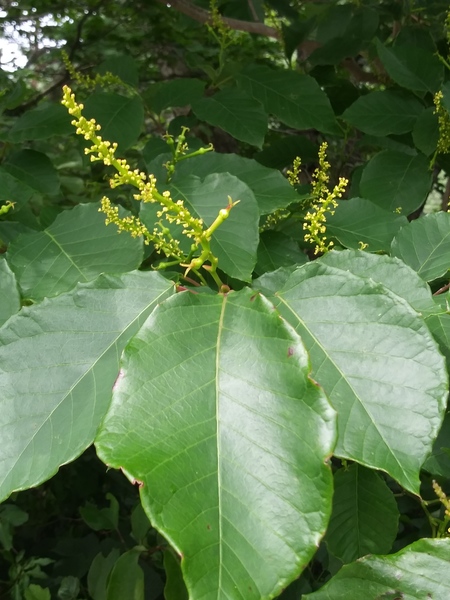
Neoshirakia japonica
Japanese name: シラキ (白木)
Scientific name: Neoshirakia japonica
[Overview]
A deciduous small tree 4–6 m tall, found in beech forests in the mountains and secondary forests at low elevations, and especially common in moist places such as along mountain streams.
A white latex exudes when the plant is damaged.
The bark is grayish white with shallow vertical fissures.
The leaves are simple and alternate, ovate-elliptic, 7–17 cm long, with a pointed tip.
The leaf margins are entire.
The petiole is about 1–3 cm long and hairless, with 2–4 glandular dots at the junction with the leaf or at the base of the leaf.
The leaves turn red in autumn.
There are male flowers and female flowers.
Racemes emerge at the branch tips, bearing many male flowers in the upper part and 1–3 female flowers in the lower part, though sometimes no female flowers are borne.
Neither male nor female flowers have petals.
The male flowers have a jointed stalk 2.5–3 mm long, a saucer-shaped calyx, and 2–3 stamens.
The female flowers have a stalk 7 mm long, a 3-lobed calyx, and 3 styles.
The fruit is a flattened-spherical capsule about 1.8 cm in diameter with 3 rounded ridges, and it splits open when ripe.
The seeds are spherical, with a pale brown ground color and a blackish brown tiger-stripe pattern.
[Uses]
The root bark is used medicinally.
Oil obtained from the seeds was used for lamps and as a hair dressing.
The wood is used for crafts and similar items.
[Cultivation]
Propagate from seed.
It grows well in any soil as long as the site is sunny and well drained.
For potted plants, water thoroughly when the soil surface dries; for plants in the ground, rainfall is sufficient.
Apply organic fertilizer in winter, and for potted plants also apply thank-you fertilizer after flowering, judging by how the plant is growing.
There are no particular pests or diseases.
[Notes]
The Japanese name is said to derive from the whiteness of the wood.
Details
Translated from our Japanese encyclopedia. If anything differs, the Japanese page is correct.