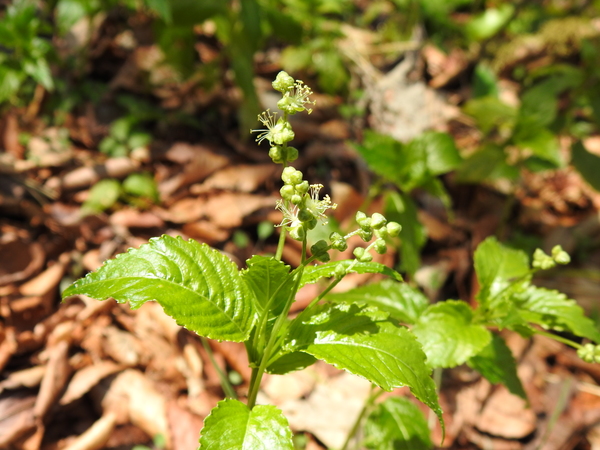
Japanese name: ヤマアイ Scientific name:Mercurialis leiocarpa
[Overview]
A perennial about 40 cm tall, found in forests and at forest edges.
It has thin rhizomes creeping horizontally underground.
The stem is erect and hairless.
The leaves are simple and opposite, lanceolate to ovate, 2.5–12.5 cm long and 1.5–5 cm wide.
The leaf surface is glossy, with sunken veins and sparse hairs.
The leaf margins are toothed.
The petioles are 1.3–5.5 cm long, and become shorter on the upper leaves of the stem.
At the base of the petiole there are lanceolate to ovate stipules.
It is dioecious or monoecious.
Dense spike-like inflorescences 1–12.5 cm long emerge from the leaf axils and bear small green flowers sparsely.
The flowers have no petals.
The fruit is a capsule 0.5–0.6 cm wide.
[Uses]
The stems and leaves are used as a dye, said to be the oldest dye in Japan.
It is also used medicinally.
[Cultivation]
Propagate by division or cuttings.
It prefers partial shade with good drainage and moderate moisture.
It is susceptible to summer dryness, so take care.
Apply organic fertilizer in early summer and autumn.
There are no particular pests or diseases.