
Plant Encyclopedia

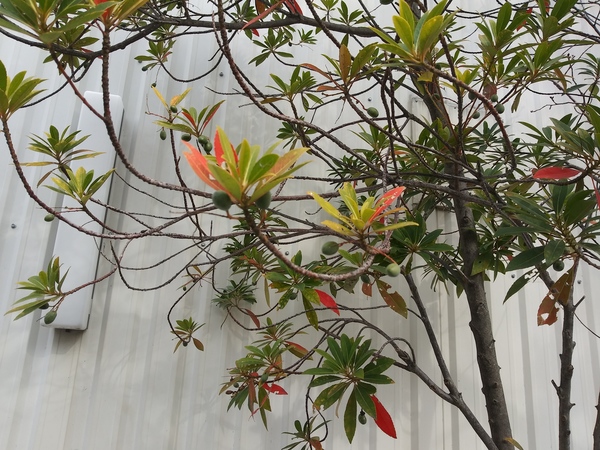
Elaeocarpus zollingeri var. zollingeri ("Horutonoki")
Japanese name: ホルトノキ
Scientific name: Elaeocarpus zollingeri var. zollingeri
[Overview]
An evergreen tree 10–15 m tall, often found in evergreen forests along the coast.
It often branches in the upper part of the tree, giving a rounded crown.
The leaves are simple and alternate, tend to cluster at the branch tips, and are oblanceolate to oblong-lanceolate, 5–12 cm long and 1.4–3 cm wide; they are somewhat thick, hairless on both surfaces, and the base gradually narrows into the leaf stalk.
There is a webbed membrane in the vein axils on the underside of the leaf, and the midrib on the underside, together with the leaf stalk, is often reddish.
The leaf margins have blunt teeth.
The leaf stalk is short, 0.5–1.5 cm long, and slightly swollen at the base.
Old leaves turn red before falling, so red leaves are mixed in throughout the year.
Racemes 4–8 cm long arise from the leaf axils and bear many flowers.
The flowers are white and 5-petaled; the petals are more than twice as long as the sepals and are finely split into thread-like segments.
The fruit is an elliptic drupe 1.5–2 cm long, ripening to indigo-black to blackish purple, and resembles an olive.
[Uses]
The bark, branches and leaves are used as a dye for Oshima-tsumugi (a type of silk fabric).
The wood is used as construction material.
[Cultivation]
Propagate from seed or by cuttings.
Suitable for planting in southern Kanto and areas to the south; it prefers a sunny, well-drained place.
Once established, rainfall is sufficient.
Apply organic fertilizer in winter.
There are no particular pests or diseases.
[Notes]
The Japanese name is a corruption of "Portugal tree"; it was formerly a name for the olive, but this tree came to be called by it because it was mistaken for the olive.
Details
Translated from our Japanese encyclopedia. If anything differs, the Japanese page is correct.