
Plant Encyclopedia

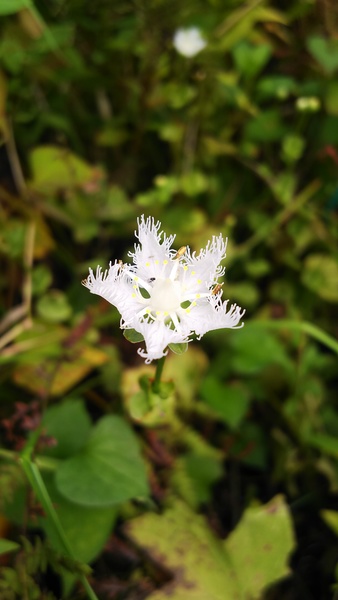
Parnassia foliosa var. foliosa ("Shirahigeso")
Japanese name: シラヒゲソウ (白髭草)
Scientific name: Parnassia foliosa var. foliosa
[Overview]
A perennial 15–30 cm tall, found in sunny wetlands and along mountain streams in the mountains.
It has a short rhizome.
There are basal leaves and stem leaves; the basal leaves are round and heart-shaped, 1.5–4 cm in both length and width, with long leaf stalks.
Several stem leaves are borne alternately on the flower stem; they have no leaf stalk, and their bases clasp the stem.
The leaf margins are entire.
A single white 5-petaled flower, 2–2.5 cm across, is borne at the tip of the flower stem, which is 15–30 cm tall.
The petals are ovate, with margins finely cut into threads.
The staminodes are divided into 3 lobes and have spherical glands at the tips.
The anthers are grayish white.
The fruit is a capsule about 0.6 cm long.
[Cultivation]
Propagate from seed or by division.
It prefers soil that is well drained and retains water well; Kiryu-suna (Kiryu sand) or soil for mountain wildflowers works well.
In warm regions the leaves scorch easily in the sun and plants are often stuffy, so from autumn to spring place it in a sunny, airy spot, and from early summer to summer in a cool, airy place in partial shade.
Water every day from spring to autumn so that it never dries out, and even during dormancy water enough to keep it from becoming extremely dry.
Less fertilizer is fine; give diluted liquid fertilizer in spring and autumn, and make sure no fertilizer remains in midsummer.
There are no particular pests or diseases.
[Notes]
The name comes from the cuts in the petals.
Details
Translated from our Japanese encyclopedia. If anything differs, the Japanese page is correct.