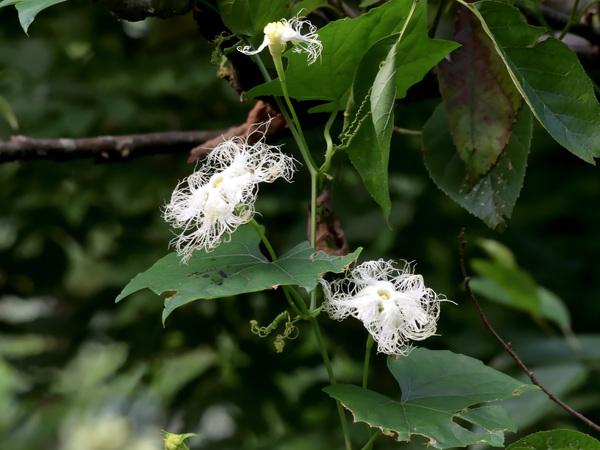
Trichosanthes kirilowii var. japonica("Kikarasuri")
Japanese name: キカラスウリ(黄烏瓜) Scientific name:Trichosanthes kirilowii var. japonica
[Overview]
A climbing perennial found at forest edges, in thickets and along roadsides.
It has thick, long tuberous roots.
The tendrils have 2–5 branches.
The leaves are alternate and round-cordate, 3–5-lobed or with toothed margins.
The upper surface of the leaves is glossy, with sparse short hairs.
It is dioecious.
Both male and female flowers open in the evening and usually wither by the next morning.
The male inflorescence is about 10–20 cm long, and the female flowers are solitary in the leaf axils.
The flowers are white; the corolla is usually 5-lobed, with lace-like split margins that spread out to as much as 5–10 cm across.
The floral tube is very long, and pollination is by nocturnal hawkmoths.
The bracts are large, ovate, 1.5–2.5 cm long, with large teeth.
The fruit is a globose to ovoid berry 7–10 cm long.
Young fruits are green and turn yellow when ripe.
The fruit stalk is 3–5 cm long.
The seeds are flat, elliptical, 1.1–1.4 cm long, and pale blackish brown.
[Uses]
The roots and seeds are used medicinally.
Tenkafun (a fine powder) is made from the starch of the roots.
The fruits are sweet and can be eaten, as can the young shoots.