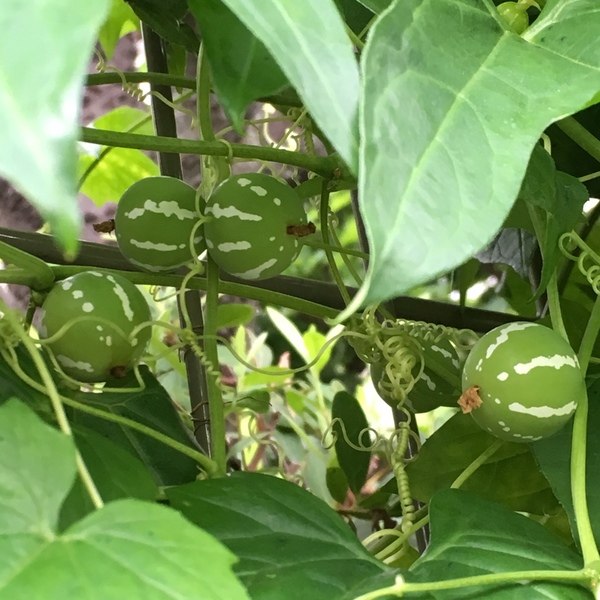
Japanese name: オキナワスズメウリ(沖縄雀瓜) Scientific name:Diplocyclos palmatus
[Overview]
A climbing annual that grows by winding its tendrils around other objects.
The leaves are alternate, heart-shaped, about 10 cm both in length and width, and palmately cut to a medium depth into 5–7 lobes.
The leaf lobes are pointed at the tip, the surface is rough, and the leaf margins have fine serration.
The petiole is 3–5 cm long.
The tendrils fork in two.
There are male and female flowers, borne in clusters in the leaf axils, both white and about 1 cm across.
The corolla is 5-lobed.
The fruit is a spherical berry 2 cm across with white vertical lines, which turns red when ripe.
The fruit is bitter and poisonous, so it cannot be eaten.
[Uses]
It is grown for ornamental purposes for its striped fruits.
[Cultivation]
Propagate from seed.
The suitable area for cultivation is the Kanto region and south.
As long as the site is sunny, it is not particular about soil.
Prepare a stake or netting for it to wind around.
Rainfall is sufficient for watering, but it wilts easily, so water it if the leaves begin to droop.
Apply slow-release fertilizer once a month or liquid fertilizer once a week.
There are no particular pests or diseases.
Japan (Ryukyu: Kuchinoshima in the Tokara Islands and south), Old World tropics (Taiwan, southern China to India, Malaysia, New Guinea, northern Australia, tropical Africa)
Growth form
Climbing
Leaf shape
Lobed leaf
Leaf arrangement
Alternate
Leaf margin
Serrate
Inflorescence
Fascicled
Flower color
White
Flower diameter
10
Fruit color
Multicolor
Leaf color
Green
Availability of seeds and plants
Low
Form sold
Seeds, Seedlings
Propagation
Seed
Sun exposure
Full sun
Water needs
Moderate
Soil needs
Required
Tolerance
Heat tolerance, Cold intolerance
Suitable uses
Parks and gardens
Uses
Wreath
Japan Flower Trade Code
49607
Translated from our Japanese encyclopedia. If anything differs, the Japanese page is correct.