
Plant Encyclopedia

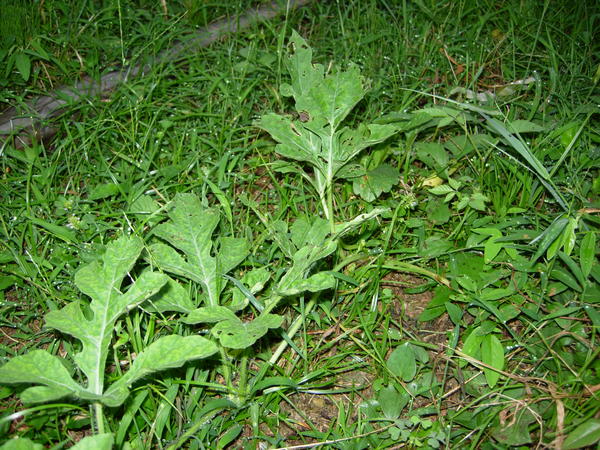
Citrullus lanatus (water melon, "Suika")
Japanese name: スイカ (西瓜)
Scientific name: Citrullus lanatus
[Overview]
A climbing annual.
The vine creeps along the ground and can reach 7–10 m in length.
The vine has coarse hairs.
It twines around surrounding grasses and other plants with tendrils from the leaf axils, which hold the vine so that the wind does not whip it about.
Leaves are simple and alternate with long petioles, ovate to ovate-elliptic, and pinnately deeply divided into 3–4 lobes.
There are male and female flowers, solitary in the leaf axils, yellow, about 3.5 cm across, with a 5-lobed corolla.
The first female flower forms at the 9th–15th node of the main vine, and thereafter further ones form every 5–6 nodes.
Male flowers form between the female flowers.
The fruit ripens about 30 days after flowering.
Most varieties grown in Japan are spherical and green with vertical stripes, but there are also oblong ones, and the color of the rind varies from dark green to green, yellow, white and so on.
The vertical stripes also vary from thick and black to pale and thin.
The flesh also comes in red, yellow, deep pink, orange, white and other colors.
In China there are also varieties grown for their edible seeds.
[History]
It was cultivated by the ancient Egyptians 4000 years ago, reached Greece 3000 years ago, and arrived in Rome early in the Common Era.
It was introduced to central Europe in the 17th century, and spread to America with the discovery of the New World.
It reached China in the 11th century via the Silk Road.
In Japan, the name appears in the Kuge Nikkoshu from the end of the Northern and Southern Courts period, and there is a theory that seeds were brought by the Portuguese in 1579; the name is also found in the Zotei Buko Nenpyo of 1627 and the Nogyo Zensho of around 1640.
European and American varieties were introduced in the early Meiji era, and it spread rapidly after breeding improvement began in the Taisho era.
[Uses]
Besides being used as a fruit, it is also processed into watermelon sugar and pickles.
[Cultivation]
It prefers a sunny, well-drained site.
A row width of 2 m and a plant spacing of 1.5 m are necessary.
A minimum soil temperature of 17°C or more is needed at planting, so use mulching to raise the soil temperature.
Pinch the tip when there are 5–6 true leaves to encourage secondary vines.
When the secondary vines have grown, select several well-developed ones and keep them.
Rearrange the secondary vines as appropriate for the growing area.
Once the vines begin to extend, lay straw to prevent mud splashing back and to curb the rise in soil temperature.
For large-fruited watermelons, leave only about 2 tertiary vines at the base of each secondary vine, but for small-fruited watermelons, let the tertiary vines grow somewhat as well to secure leaf area.
When the female flowers open, pollinate by hand by about 9 a.m.
When the fruits reach the size of a baseball, leave the well-shaped ones and thin to 1 fruit per branch.
After fruit set, apply additional fertilizer so that nutrients do not run out.
Propagation is generally by grafting onto rootstocks such as bottle gourd or pumpkin.
Pests and diseases include anthracnose, gummy stem blight, powdery mildew, brown rot, acute wilt, mosaic disease, melon leaf beetle, aphids, spider mites, cucurbit looper, greenhouse whitefly and melonworm.
It dislikes growing in the same place year after year, so choose a different site each year and use grafted seedlings as much as possible to avoid soil-borne diseases.
[Notes]
The Ministry of Agriculture, Forestry and Fisheries classifies the watermelon not as a fruit but as a fruit-type vegetable.
Details
Japanese: スイカ(西瓜)
Translated from our Japanese encyclopedia. If anything differs, the Japanese page is correct.