
Plant Encyclopedia

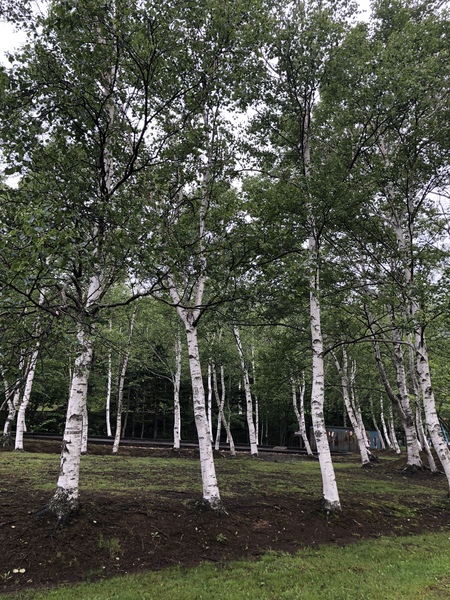
Betula platyphylla var. japonica (Japanese white birch, "Shirakanba")
Japanese name: シラカンバ (白樺)
Scientific name: Betula platyphylla var. japonica
[Overview]
A deciduous tree reaching 30 m in height and 1 m in diameter.
It prefers bright places, grows quickly, and often forms pure stands in marshlands and in areas burned by forest fires.
The crown is ovate.
The bark is white and glossy, and peels off in thin, paper-like horizontal strips.
Leaves are simple, alternate on long shoots and borne two at a time on short shoots, ovate-rhombic to triangular broadly ovate, 5–9 cm long and 4–7 cm wide.
The leaves are somewhat thick, the margins are doubly serrate (rarely singly serrate), and they turn yellow in autumn.
The leaf stalk is 1–3.5 cm long.
There are male and female flowers.
The male inflorescence is a catkin 5–7 cm long and 0.4–0.7 cm wide, with one or two hanging from the tips of long shoots.
The female inflorescence is cylindrical, 3–4.5 cm long and 0.8–1 cm wide, and hangs from the tips of short shoots.
The flowers are wind-pollinated.
The fruits are flattened samaras, many of which are contained in the hanging fruiting spike, 2–3 mm long and 4–5 mm wide.
The fruits have wings 1.5–2 times the width of the fruit.
[Uses]
Because its white trunk surface is beautiful, it is used as a street tree in highlands and similar places.
The bark burns well, so it is used as a fire starter.
The wood is used for furniture, interiors, pulp and the like.
[Cultivation]
Propagate from seed or by grafting.
It prefers a sunny place with good drainage and good water retention.
In cool regions it grows well regardless of soil type.
It will also grow in other regions, but its lifespan is shorter than in cold regions, and the color of the trunk is poorer.
Water when the soil surface dries so that the base of the plant does not dry out.
Fertilizer is not particularly necessary.
It dislikes being transplanted once it has taken root.
Pests include teppo-mushi (larvae of longhorn beetles).
It is somewhat sensitive to air pollution.
[Notes]
It is a cause of hay fever, mainly in Hokkaido.
Details
Japanese: シラカンバ(白樺)、シラカバ(白樺)、ホソバシラカンバ(細葉白樺)、エゾノオオシラカンバ(蝦夷大白樺)、ガンピ(雁皮)
Translated from our Japanese encyclopedia. If anything differs, the Japanese page is correct.