
Plant Encyclopedia

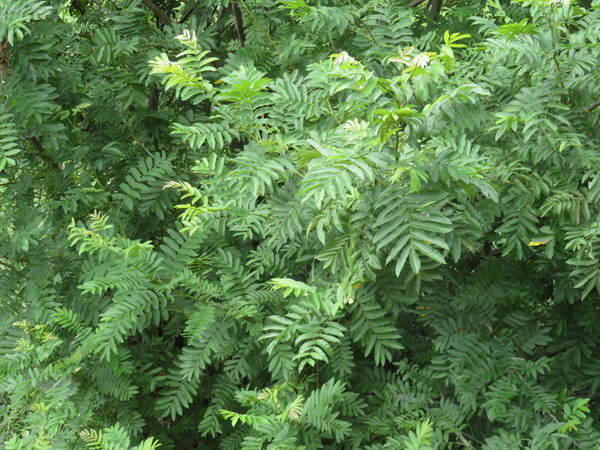
Pterocarya stenoptera (Chinese wingnut, "Shinasawagurumi")
Japanese name: シナサワグルミ (支那沢胡桃)
Scientific name: Pterocarya stenoptera
[Overview]
A deciduous tree about 25–30 m tall.
In its native habitat it is found on mountain slopes and riverbanks.
The leaves are alternate, even-pinnately compound, 8–25 cm long, and consist of 5–11 pairs of leaflets.
The leaflets are oblong, 8–12 cm long and 2–3 cm wide, with fine teeth on the margin.
Gland dots are conspicuous on the underside of the leaves.
The leaf axis has narrow wings.
There are male flowers and female flowers.
The female inflorescence is borne at the tip of the current year's branch, and the male inflorescence at the leaf scars of the previous year's branch or in the leaf axils at the base of the current year's branch; both are catkins.
Each female flower has one pistil enclosed in four tepals, which are in turn enclosed in one bract and two bracteoles.
Each male flower has several stamens enclosed in 1–4 tepals, which are in turn enclosed in one bract and two bracteoles.
The fruit is a nut about 6–7 mm long, borne on a fruiting spike 20–45 cm long, enclosed in the tepals, with large winged bracteoles about 1.2–2.5 cm long.
[History]
It was introduced to Europe in 1844 and arrived in Japan at the beginning of the Meiji era.
[Uses]
The bark is used medicinally and as a dye.
[Cultivation]
Propagate from seed, by layering, by root cuttings, or from suckers.
It prefers a sunny place with deep, moist soil, but it also grows well in dry land.
It is vigorous and easy to grow, but it becomes a large tree and needs plenty of space.
There are no particular pests or diseases.
Details
Japanese: シナサワグルミ(支那沢胡桃)、カンポウフウ(嵌寶楓)、カンベイジュ(嵌寶樹)
Translated from our Japanese encyclopedia. If anything differs, the Japanese page is correct.