
Plant Encyclopedia

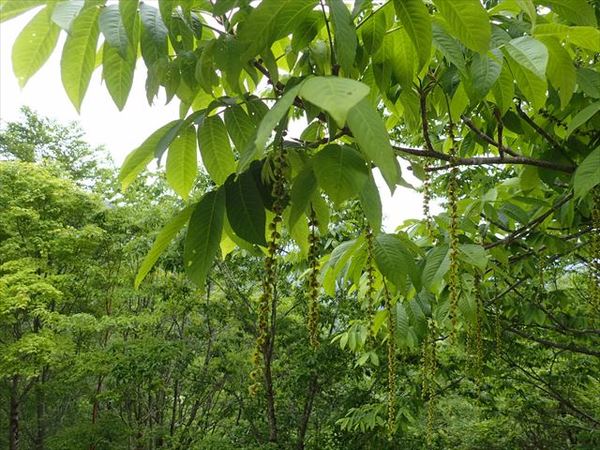
Pterocarya rhoifolia (Japanese wingnut, "Sawagurumi")
Japanese name: サワグルミ (沢胡桃)
Scientific name: Pterocarya rhoifolia
[Overview]
A deciduous tree 10–20 m tall, found on gravelly ground along mountain rivers.
Large trees reach as much as 30 m.
Leaf scars remain on the branches; the scars are rounded inverted triangles with vascular bundle marks at the three corners.
The leaves are alternate, odd-pinnately compound, 20–30 cm long, and consist of 11–21 leaflets.
The leaflets are oblong, 5–12 cm long and 1.5–4 cm wide, with fine teeth on the margin.
There are male flowers and female flowers.
The female inflorescence is borne at the branch tips and the male inflorescence in the leaf axils below it; both are catkins.
The female inflorescence is 10–20 cm long, and each female flower has one pistil enclosed in four tepals, which are in turn enclosed in one bract and two bracteoles.
The male inflorescence is 5–15 cm long, and each male flower has 8–13 stamens enclosed in one tepal, which is in turn enclosed in one bract and two bracteoles.
The fruit is a nut about 8 mm long; 10–30 are borne on a fruiting spike 30–40 cm long, enclosed in the tepals, with large winged bracteoles about 1.5 cm long.
[Uses]
The leaves are used medicinally and the bark as a dye.
[Cultivation]
Propagate from seed, by layering, by root cuttings, or from suckers.
It prefers a sunny place with deep, moist soil, but it also grows well in dry land.
It is vigorous and easy to grow, but it becomes a large tree and needs plenty of space.
There are no particular pests or diseases.
Details
Japanese: サワグルミ(沢胡桃)
Translated from our Japanese encyclopedia. If anything differs, the Japanese page is correct.