
Plant Encyclopedia

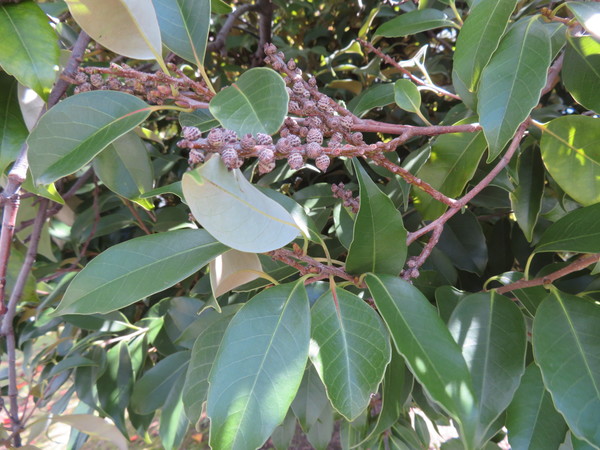
Lithocarpus glaber ("Shiribukagashi")
Japanese name: シリブカガシ (尻深樫)
Scientific name: Lithocarpus glaber
[Overview]
An evergreen tree reaching 15 m in height and 50 cm in trunk diameter.
The trunk is erect, and the bark is grayish black with vertical rows of lenticels.
Young branches are densely covered with short yellowish-brown hairs.
Leaves are simple and alternate, oblong, 8–12 cm long, thick and glossy on the upper surface.
The underside of the leaf appears pale brown to silvery gray.
The leaf margin is entire, or has wavy serrations near the tip.
There are male and female flowers.
The male inflorescence is a catkin 6–9 cm long, several of which grow obliquely upward from the leaf axils of new branches.
The female inflorescence is a catkin 5–9 cm long, borne in the upper leaf axils of new branches, and male flowers are often also borne on the upper part of the female inflorescence.
Both male and female flowers are small and pale yellowish brown, with a 6-lobed perianth.
The fruit is an elliptic nut (acorn) 2 cm long, ripening brown by autumn of the following year.
The cupule (acorn cap) is bowl-shaped, and the involucre scales are arranged like overlapping roof tiles.
The base of the nut, where it attaches to the cupule, is hollow.
[Uses]
The acorns have little astringency, so they need no removal of bitterness and can be roasted and eaten as they are.
The wood is used for construction, utensils and charcoal.
[Cultivation]
Propagate from seed.
The germination rate drops if the acorns are dried, so sow them immediately or store them kept moist until spring.
The suitable planting area is south of the Kanto region.
It prefers sun, good air circulation, good drainage, and fertile, slightly moist soil.
Apply organic fertilizer as fertilizer in winter and slow-release fertilizer in autumn.
Scale insects can occur.
[Notes]
The Japanese name comes from the hollow at the base (the "bottom") of the nut.
Details
Translated from our Japanese encyclopedia. If anything differs, the Japanese page is correct.