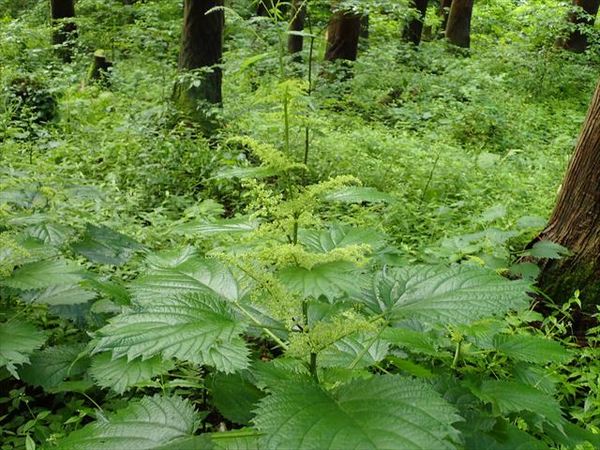
Japanese name: ミヤマイラクサ(深山刺草) Scientific name:Laportea cuspidata
[Overview]
A perennial 0.4–1 m tall, found in damp places such as along streams in mountain forests.
The whole plant bears stinging hairs, and touching them causes intense pain.
The leaves are simple and alternate, 8–20 cm long and 5–15 cm wide, broadly ovate to round, with a tip tapered like a tail.
The leaf margin has coarse teeth.
The leaves have long petioles and usually do not bear bulbils in the axils.
The form that bears bulbils is called Komochi-miyama-irakusa.
There are male and female flowers; in the upper part of the stem are spike-like to raceme-like female inflorescences 10–30 cm long, and in the lower part are panicle-like male inflorescences 5–10 cm long.
The stalk of the female inflorescence is very short.
Both male and female flowers are small; male flowers are white with 5 tepals and 5 stamens.
Female flowers are green with 4 tepals, and the stigma is long and linear.
The fruit is an achene, a distorted ellipse about 2 mm long, and 2 of the tepals enlarge and persist.
[Uses]
The whole plant is called jinma and is used medicinally, for example as a local irritant.
The young shoots are used as a wild vegetable.
The stem fibers are tough and were used to weave cloth.